
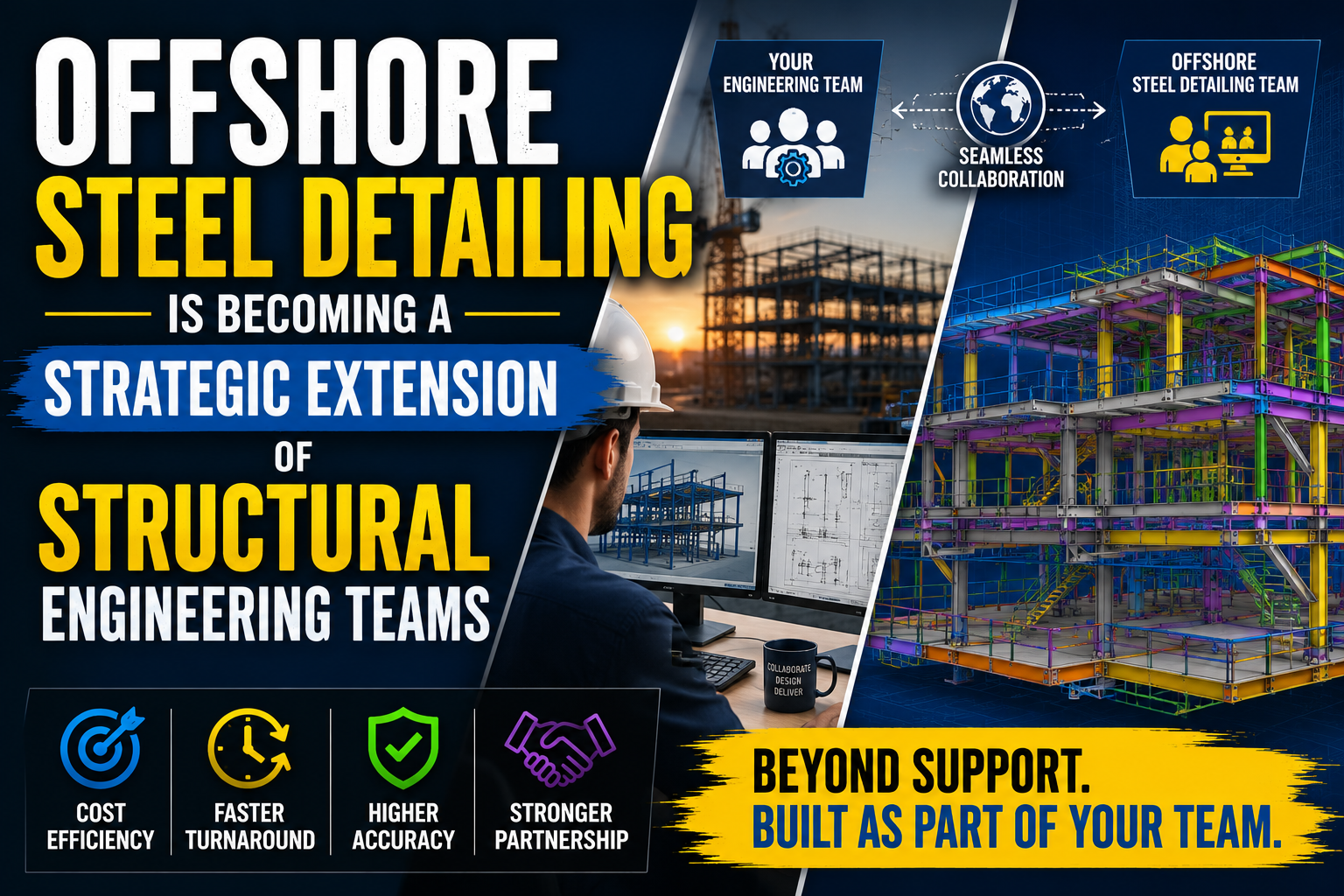
Structural engineering firms are under more pressure than ever—tighter deadlines, complex projects, and mounting competition. Yet many are discovering a way to stay ahead: integrating offshore steel detailing into their core workflows. This post explores how Offshore Steel Detailing Services have evolved from a cost-cutting workaround into a legitimate strategic advantage, and what your firm should know before making the move.
What Is Offshore Steel Detailing—and Why Does It Matter?
Steel detailing is the process of producing detailed drawings for fabricators and erectors. These drawings specify the size, shape, and location of every structural steel element in a building or infrastructure project—from connection plates to anchor bolts. Without precise detailing, fabrication errors, costly rework, and project delays are almost inevitable.
Offshore steel detailing takes this technical function and places it in the hands of specialized remote teams—often based in countries like India, the Philippines, or Eastern Europe—who work as an extension of a structural engineering firm's in-house staff. Far from being a fringe practice, Archdraw outsourcing and similar models have matured into a well-established approach used by firms across the US, UK, and Australia.
How Did Structural Engineering Get Here?
The Limitations of Traditional, In-House Detailing
Historically, steel detailing was done entirely in-house or handed off to local subcontractors. Both approaches had obvious constraints. In-house teams were expensive to build and maintain, especially for firms with fluctuating project volumes. Local subcontractors offered flexibility but rarely delivered consistent quality or deep familiarity with a firm's standards and workflows.
Scaling up for a large project often meant rushed hiring, compressed timelines, and stress across the board. Scaling back down afterward was equally painful.
Globalization Changed the Rules
The arrival of high-speed internet, cloud collaboration platforms, and internationally recognized BIM software fundamentally shifted what was possible. Structural engineering firms realized they could access skilled drafters and detailers across the globe—without sacrificing quality or control. Offshore Steel Detailing Services became a viable answer to a persistent problem: how do you deliver more, faster, without proportionally increasing your overhead?
The Strategic Advantages of Offshore Steel Detailing
Cost-Effectiveness Without Compromising Quality
Labor cost differentials between regions remain significant. Firms leveraging Archdraw outsourcing and similar services often report savings of 40–60% on detailing costs compared to equivalent local talent. Crucially, these savings don't come at the expense of quality when the right partner is chosen. Offshore teams often specialize exclusively in steel detailing, meaning their expertise can be deeper than that of a generalist in-house hire.
Access to a Global Talent Pool
Skilled steel detailers with experience in Tekla Structures, Revit, AutoCAD, and SDS/2 are not evenly distributed around the world. Offshore Steel Detailing Services give engineering firms access to professionals trained specifically for this niche—people who spend their entire careers working on connection details, shop drawings, and erection drawings. That level of specialization is hard to replicate in a small or mid-sized in-house team.
24/7 Workflow Through Time Zone Advantages
One of the most underappreciated benefits of offshore partnerships is the time zone effect. A US-based firm can hand off a project at the end of the business day and receive completed work the following morning. This round-the-clock workflow can significantly compress project timelines—an increasingly important factor as clients demand faster turnarounds.
Freeing In-House Teams to Focus on What Matters
When in-house engineers aren't bogged down in detailing tasks, they can focus on structural analysis, client relationships, and project management. Archdraw outsourcing and comparable models allow firms to position their senior staff where they add the most strategic value, rather than routing them into high-volume drafting work.
What Makes an Offshore Partnership Actually Work?
Communication and Collaboration Tools
Success in offshore detailing depends heavily on clear, structured communication. Firms that thrive in these arrangements typically invest in shared project management platforms—tools like Procore, Bluebeam, or even well-configured Microsoft Teams environments. Regular video calls, standardized file-naming conventions, and clearly written briefs go a long way toward preventing costly miscommunications.
Quality Control and Assurance
Quality must be embedded in the process, not bolted on at the end. Leading firms establish formal review checkpoints, require model audits at defined project milestones, and maintain a senior engineer on the in-house side who owns accountability for the final drawings. Offshore Steel Detailing Services that are serious about quality will welcome this structure—it protects both parties.
Data Security and Intellectual Property
Project drawings and structural models represent significant intellectual property. Before engaging any offshore partner, firms should establish clear contractual terms around data ownership, confidentiality, and how files are stored and transferred. Non-disclosure agreements, secure FTP systems, and cloud platforms with enterprise-grade encryption are baseline requirements—not optional extras.
Cultural Alignment and Working Style
The best offshore partnerships are built on mutual respect and shared expectations. Cultural differences in communication style, hierarchy, and feedback norms can create friction if left unaddressed. Firms that take time to understand how their offshore team prefers to work—and to articulate their own standards clearly—tend to build longer-lasting, more productive relationships.
The Future of Offshore Steel Detailing
BIM Integration and AI-Assisted Workflows
Building Information Modeling has already transformed steel detailing, enabling clash detection, quantity takeoffs, and fabrication data to flow from a single model. As AI tools mature, they're beginning to assist with automated connection design, error checking, and even drawing generation. Offshore Steel Detailing Services that invest in these technologies are positioning themselves as genuine engineering partners, not just low-cost labor.
Archdraw outsourcing is one example of a model evolving in step with these technological shifts—moving from basic drafting support toward integrated, technology-enabled collaboration.
The Rise of Specialized Remote Teams
The broader trend toward remote work has normalized distributed teams across nearly every industry. In structural engineering, this is accelerating the shift toward dedicated offshore detailing units that function as seamless extensions of in-house staff. Firms that build strong offshore relationships now will have a significant competitive advantage as project complexity grows and talent shortages intensify in domestic markets.
Rethinking How Structural Engineering Teams Are Built
Offshore Steel Detailing Services are no longer a compromise—they're a strategic decision. Firms that approach offshore partnerships with the same rigor they apply to any other business relationship can unlock meaningful gains in speed, cost efficiency, and capacity.
The structural engineering firms best positioned for the next decade won't necessarily be the largest. They'll be the most adaptable—those who know how to combine in-house expertise with the right external capabilities. Archdraw outsourcing and similar models offer exactly that kind of flexibility.
For firms still on the fence, the question isn't whether offshore steel detailing works. It's whether your organization is ready to implement it well.
Frequently Asked Questions
What is offshore steel detailing?
Offshore steel detailing involves outsourcing the production of structural steel drawings—including shop drawings, erection drawings, and connection details—to specialized remote teams in other countries. These teams work as an extension of a structural engineering firm's in-house staff.
How much can firms save with offshore steel detailing services?
Cost savings vary by region and project type, but firms commonly report reductions of 40–60% on detailing costs compared to local in-house or subcontracted work, without sacrificing quality when the right partner is selected.
What software do offshore steel detailers typically use?
Most experienced offshore teams work with industry-standard platforms including Tekla Structures, Autodesk Revit, AutoCAD, and SDS/2—the same tools used by in-house teams in the US, UK, and Australia.
How do firms maintain quality control with offshore partners?
Quality is maintained through structured review checkpoints, model audits at key milestones, standardized briefs, and clear accountability on the in-house side. Reputable offshore partners will actively support these processes.
Is offshore steel detailing suitable for small structural engineering firms?
Yes. Offshore partnerships can be scaled to match project volume, making them particularly valuable for small and mid-sized firms that can't justify maintaining a full in-house detailing team year-round.
 Never miss a story from us, get weekly updates in your inbox.