
Scrolling through short videos that draw lines across eyes can make a simple angle sound like a harsh judgment. By 2019, looksmax.org forum threads had made canthal tilt a fixed topic in communities that score faces. In 2023, a TikTok filter covered by HuffPost let anyone screenshot their eye-corner line, and some loud commenters treated a downward tilt as disqualifying with lines like "Negative canthal tilt, it's over for bro," as reported in Glamour.
Seeing those comments after getting a negative reading on a selfie can feel discouraging. Examining what the measurement captures, what the studies tested, and how head position shifts a photo gives a clearer view. The angle is real, and its power over how you come across is much smaller than the viral version suggests.
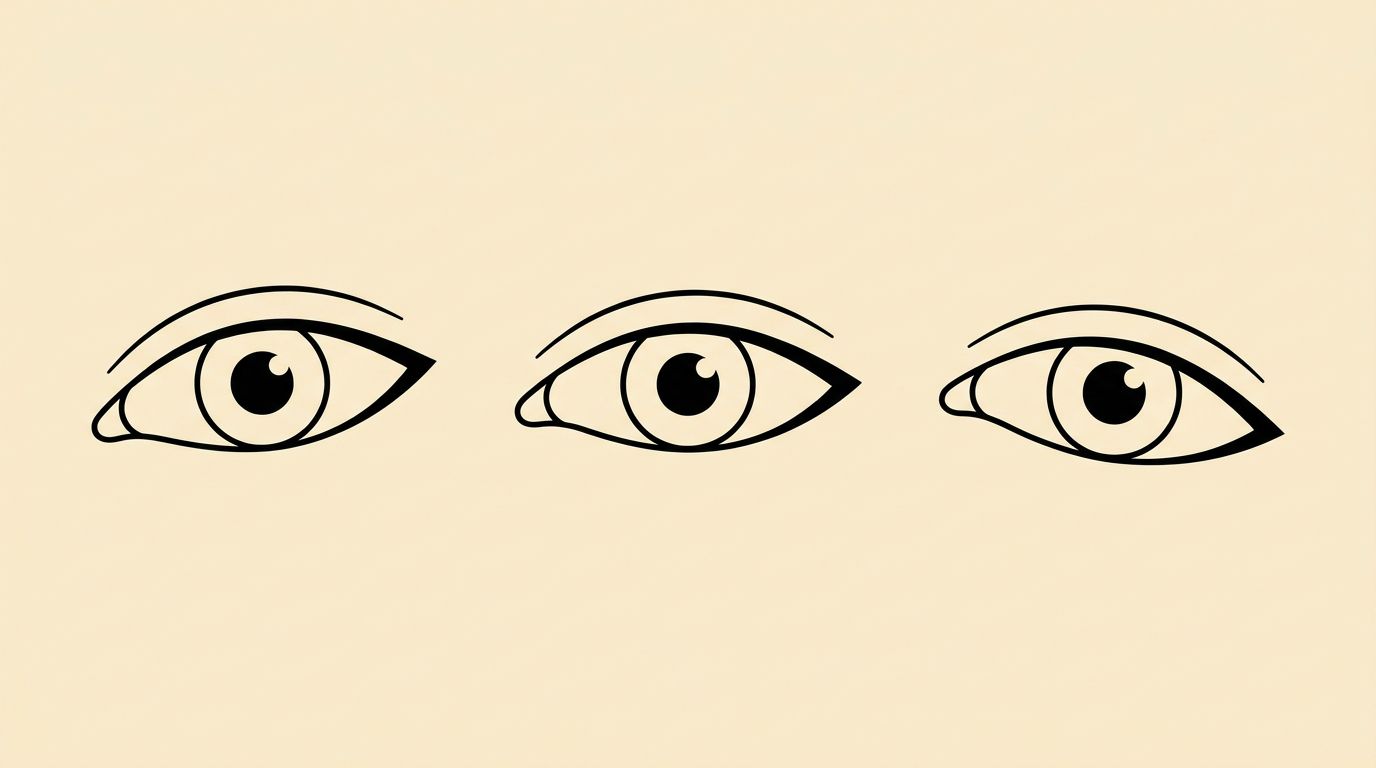
Illustration of three eye outlines with the outer corner higher, level, and lower.
What the three tilt labels mean and why ±1° is called neutral
Canthal tilt is the angle of the line from the inner corner of the eye beside the nose, the medial canthus, to the outer corner toward the temple, the lateral canthus, measured against a level horizontal. Three words describe the direction of that line: positive when the outer corner sits higher than the inner corner, negative when the outer corner sits lower, and neutral when the two corners sit at roughly the same height close to level.
Where neutral ends and positive or negative begins is a convention, a line someone drew. On the Looksmax Scale tool discussed in this article, re-analyzing the same photo rotated by ±3° moved the average by about 0.5° typically and 1.4° at most. That noise comes from Google's MediaPipe face landmark model, which places 478 landmark points on the face in your browser, placing each corner a pixel or two differently on each pass. Because one photo resolves canthal tilt to about ±1°, this tool calls readings within 1° of level neutral and prints the degrees next to the label so you can ignore the label if you prefer.
If the tool read −2.3° for you on a level photo, with your two eyes within 1° of each other, that is a fair reading. Because the tool is deterministic, the same photo will read −2.3° tomorrow, and another level photo of you taken the same way will land close to it within the roughly ±1° precision of a single photo. What that number means is a different question.
What Bashour and Geist 2007 showed and what it did not
Online claims about research proving the importance of eye tilt usually point to a 2007 forced-choice experiment by Bashour and Geist in Ophthalmic Plastic and Reconstructive Surgery. Looking at how that experiment worked shows how narrow its findings are.
The researchers showed judges pairs of female faces where one copy had its inner-corner tilt digitally accentuated while everything else about the face was held equal. Judges chose the more tilted copy 93% of the time.
That 93% figure is real evidence that people respond to the direction of the tilt when every other feature stays the same. At the same time, it is not evidence for a threshold, for a number of degrees that decides anything, or for a negative tilt being unattractive. Every face in the 2007 study was compared only with an edited version of itself, and nobody in it was rated as a defect.

Illustration of a desk with blank photo cards and a notebook.
What the 2023 celebrity study and twenty-nine portraits show
A second study cited in online discussions is a 2023 paper by Liu, Salinas, and Sharaf in Aesthetic Surgery Journal Open Forum that measured 100 facial points on 42 Caucasian celebrities. It reported 8.5° for the women and 6.5° for the men, and cited a general-population figure of about 4°. Commonly quoted reference ranges from QOVES, a web reference without peer review, put men at roughly 0° to +4° and women at roughly +2° to +8°, with women averaging a couple of degrees more than men.
Finding celebrity tilts a couple of degrees above a general-population figure says something about who gets cast and nothing about the ordinary faces that make up the rest of the range. Exact numbers also differ between sources because each study or calculator places the corner points and levels the head its own way, so 4.5° from one calculator is not the same 4.5° as another.
Run on 29 official portrait photographs, this tool's average of both eyes had a median of 4.4°, with the middle half of the portraits between 3.3° and 5.3° and the full spread from −0.1° to 10.1°. That whole adult range spans about ten degrees, and a level or slightly negative tilt is well within the range of ordinary faces.
Plastic surgeons interviewed about the trend land in the same place. Ramtin Kassir, MD, a triple board-certified facial plastic and reconstructive surgeon, told Glamour: "Attractiveness is highly subjective and can vary significantly from person to person... There is no one-size-fits-all standard." Surgeons interviewed on the record note that the angle is one feature among many and that a negative tilt is common in faces widely agreed to be attractive.
How head pose and photo error shift a reading
Because the whole range of ordinary adult faces spans about ten degrees and the gap between a slightly positive and a slightly negative tilt is two or three degrees, a slightly tilted or lowered head moves the reading by degrees on the same scale as the feature itself. Before reading too much into a positive or negative canthal tilt, consider how much each kind of head movement shifted the reading when we measured 29 real photographs:
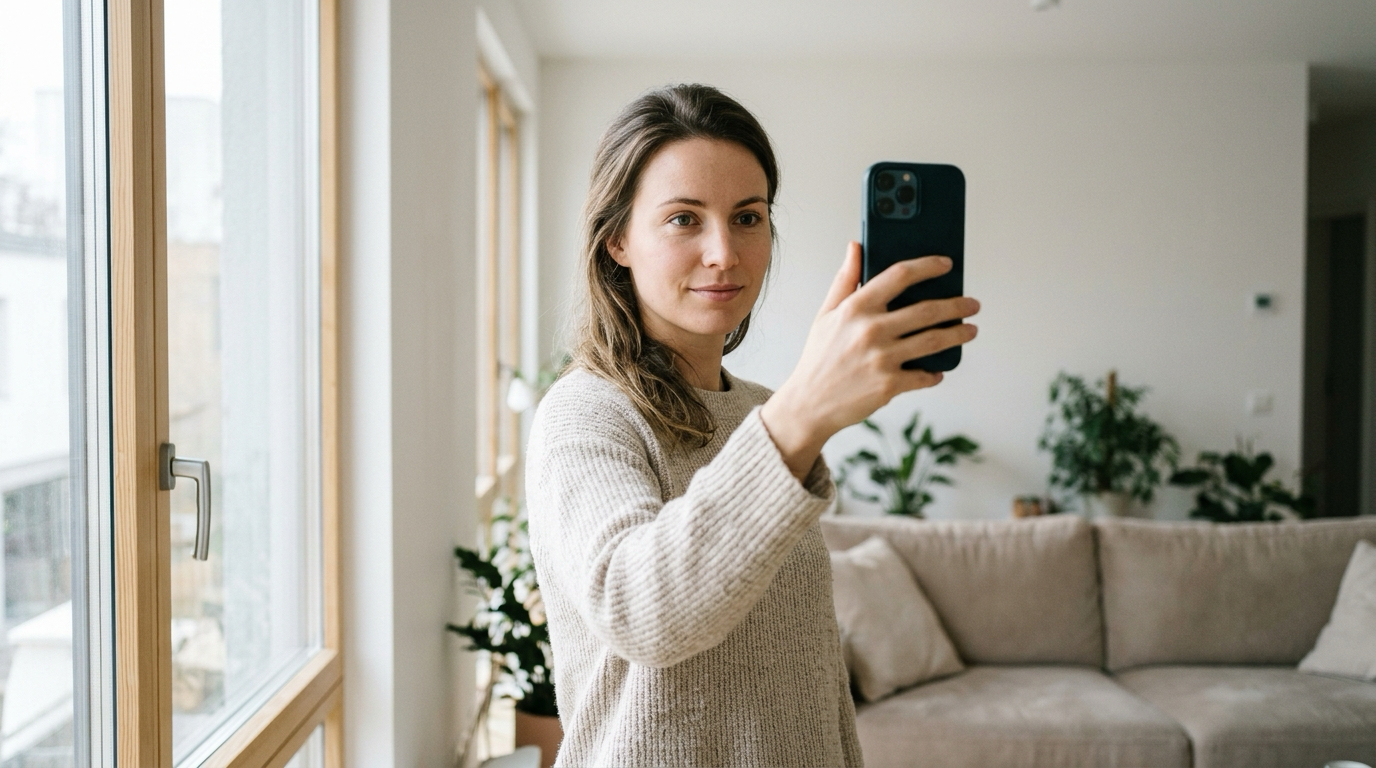
Illustration of an adult woman taking a selfie at eye level by a window.
- Head roll: Tilting the head sideways raises one outer corner and lowers the other. Measured against the photo edge across 29 portraits, each 1° of roll moved the left-right difference by 2.0° (±0.1°), so a 2° head tilt adds about 4° between the eyes while the average of both eyes barely moved (0.03° per degree). This tool levels the face before measuring using 12 matching point pairs on the cheekbones, jaw, mouth, nose, and brows, bringing the roll slope to 0.00° ± 0.08° per degree. After leveling, the average difference was about 1°, and in 27 of the 29 portraits the subject's left eye read slightly higher by 1.2° on average, so a leveled difference of about 1° sits within the tool's resolution.
- Head pitch: Dropping the chin lowered the average reading by roughly 0.25° per 1° of pitch (±0.1°) across the 29 faces. A ten-degree nod shifts the reading by about 2.5°, more than half the quoted 0° to +4° range for men. Because one photo holds too little depth information to undo a nod reliably, the photo check under your result estimates the pitch and says whether your positive, neutral, or negative verdict still holds.
- Head turn: Turning left or right within the ±11° present in those portraits produced no measurable shift in the average (0.03° ± 0.13° per degree). Photos turned, tilted, or nodded by more than 25° are refused, readings between 15° and 25° are marked low confidence, and photos within 15° are read normally with the photo check reporting what it detected.
Because a few degrees of head roll or pitch is worth as much as the entire range being argued about, celebrity tilt numbers posted online from different photos are not comparable. Taking a level, straight-on photo at eye level and checking the pose notes lets you read the angle in context without treating any reading as something that needs fixing.
Disclosure: This article was prepared for Looksmax Scale. Its Looksmax Scale canthal tilt test is the tool discussed here.
 Never miss a story from us, get weekly updates in your inbox.