
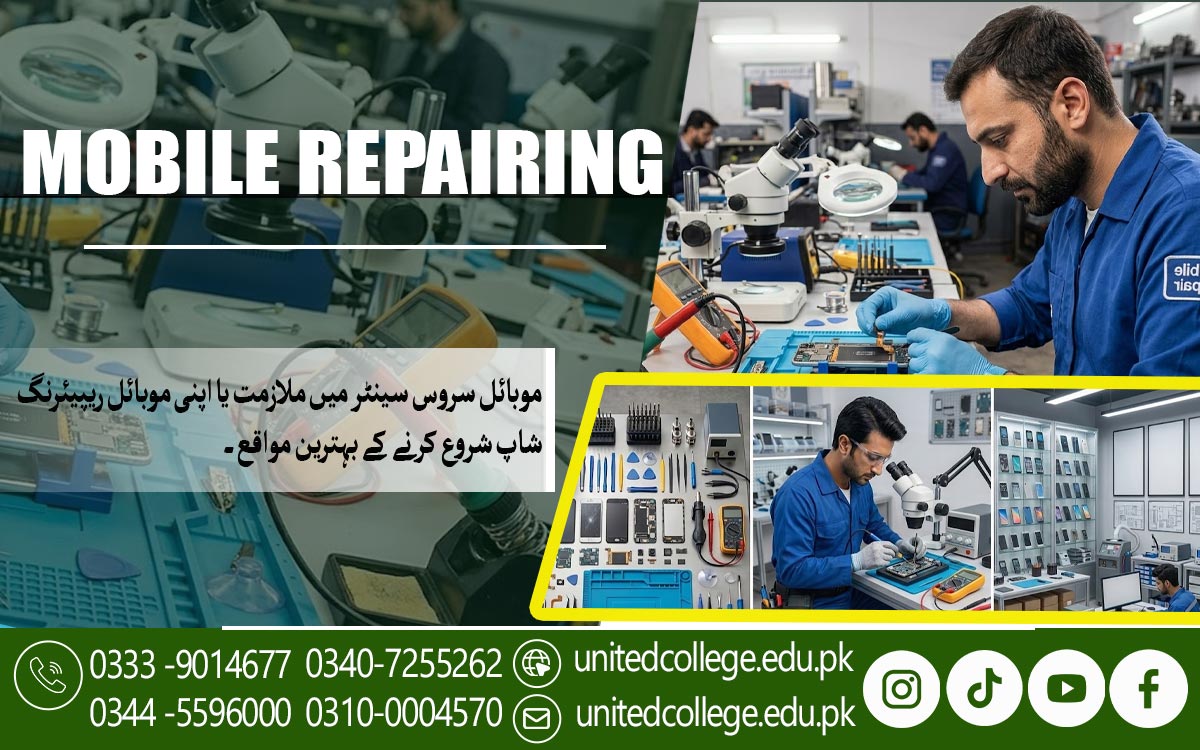
Mobile Repairing Course in Mandi Bahauddin: Build Practical Skills to Repair Modern Smartphones
Mobile phones have become an important part of everyday life. People use them for communication, education, online shopping, business, and entertainment. When a phone stops charging, develops a software problem, or suffers screen damage, skilled technicians are needed to identify the fault and find a suitable solution.
Learning how to repair mobile phones can be a useful step for people interested in technical work. The Mobile Repairing Course in Mandi Bahauddin introduces learners to the knowledge and practical skills involved in mobile phone repair and maintenance. Offered by United College of Technology, this course is relevant to beginners, students, and job seekers who want to explore the mobile repairing field.
Learn the Skills Behind Everyday Mobile Phone Repairs
Mobile repairing involves identifying problems, checking phone components, and carrying out suitable repairs. A technician must understand how different parts work together and how to recognize signs of damage.
For example, a phone that does not turn on may have a weak battery, a damaged charging port, or another internal fault. A technician needs to examine the device carefully instead of replacing parts without understanding the actual problem.
Through Mobile Repairing training in Mandi Bahauddin, learners can develop an understanding of common phone faults and the methods used to investigate them. These skills require patience, attention to detail, and regular practice.
Understand the Faults That Affect Smartphones Most Often
Mobile phones can develop different problems because of regular use, accidental damage, moisture, or internal component failure. Recognizing these problems is an important part of mobile fault diagnosis.
Some common faults include damaged screens, charging problems, weak batteries, faulty speakers, microphone issues, and phones that restart unexpectedly. Software errors can also cause devices to freeze, run slowly, or fail to start correctly.
A good repair process begins with checking the symptoms. For example, if a phone is not charging, the technician may inspect the cable, charger, charging port, and battery before deciding what needs attention.
This approach helps learners understand why proper diagnosis matters. It also reduces the risk of unnecessary repairs and helps technicians make better decisions when dealing with different smartphone models.
Develop Mobile Hardware Repair Skills Step by Step
Mobile hardware repair focuses on the physical parts inside and outside a phone. These components include the display, battery, charging port, speakers, microphones, buttons, and internal connectors.
Learners need to understand how these parts function and how damage can affect a device. They also need to learn the importance of careful handling because modern smartphones contain small, delicate components.
Practical mobile repairing involves using appropriate tools, opening devices carefully, checking connections, and assembling components correctly. Some repairs may require replacing a damaged part, while others may involve cleaning or correcting a connection.
Safe working methods are essential throughout the process. Disconnecting power when appropriate, handling batteries carefully, and following suitable repair procedures can help prevent additional damage.
Build Confidence in Mobile Software Troubleshooting
Not every mobile phone problem comes from damaged hardware. Sometimes, a device develops software issues that affect its speed, performance, or normal operation.
Mobile software troubleshooting involves checking problems related to applications, system settings, operating system errors, and startup failures. A technician may need to determine whether an issue comes from an application, a software update, or another cause.
For example, if a phone becomes unusually slow, the technician may check available storage, background applications, and system performance before considering more advanced steps.
Learners should also understand the importance of protecting personal information during software work. Backups, customer permission, and careful handling of private data are important parts of responsible mobile repair and maintenance.
Get Familiar With the Tools Used in Mobile Repairing
The right tools help technicians inspect devices, handle small components, and perform repairs more accurately. Understanding their purpose is an important part of smartphone repair training.
Common mobile repairing tools include precision screwdrivers for removing small screws, tweezers for handling delicate parts, and multimeters for checking electrical values. Soldering equipment may also be used for certain component-level repairs by people with appropriate training.
Each tool requires proper handling. Using excessive force, applying too much heat, or choosing the wrong tool can damage a phone's internal components.
Beginners should first become familiar with basic tools and their safe use. As their knowledge develops, they can gradually learn more advanced repair techniques under suitable supervision.
Turn Practice Into Better Repairing Skills
Reading about mobile phone components is useful, but practical experience is equally important. Learners need opportunities to apply their knowledge, recognize faults, and understand the steps involved in different repairs.
Starting with simple tasks can help build confidence. For example, learners can practise identifying phone components, inspecting charging accessories, recognizing common symptoms, and understanding how different parts connect.
As their experience grows, they can work toward understanding more complex faults. Repeated practice also helps develop patience, accuracy, and the ability to follow a repair process carefully.
Anyone interested in practical mobile repairing should remember that progress takes time. Different phone models may have different designs, and some repairs require specialized knowledge and equipment.
Start Learning Mobile Repairing Without Feeling Overwhelmed
The mobile repairing field can be explored by people with different educational backgrounds and levels of experience. Beginners who enjoy understanding electronic devices may find it a useful area to study.
Students can use technical training to develop practical knowledge, while job seekers may explore mobile phone repair as one possible career direction. People interested in electronics businesses may also benefit from understanding how smartphones are diagnosed and maintained.
The key is to develop a strong foundation before attempting difficult repairs. Learning basic components, understanding common faults, and practising safe handling techniques can make more advanced topics easier to understand.
Explore Potential Work Opportunities in the Mobile Repairing Field
Mobile repairing knowledge may support different work opportunities, depending on a person's practical ability, experience, and local market conditions.
Some learners may aim to work in mobile phone repair shops or electronic device service centres. Others may consider developing their skills for self-employment or eventually operating a small repair business.
Successful repair work involves more than technical knowledge. Clear communication, honest advice, responsible handling of customer devices, and a willingness to keep learning are also important.
Smartphones continue to change, so technicians need to stay familiar with new device designs and repair methods. Regular learning can help them understand newer technologies and adapt their skills over time.
These opportunities are possibilities rather than guaranteed outcomes. Actual progress depends on practical competence, experience, available resources, and customer needs.
Learn Mobile Repairing in Mandi Bahauddin With a Practical Goal
For people living in Mandi Bahauddin, exploring local technical training can be a convenient way to begin learning a new skill. It allows learners to focus on developing useful knowledge while considering their educational and professional goals.
The Mobile Repairing Course in Mandi Bahauddin, offered by United College of Technology, is relevant to individuals interested in learning about smartphone faults, mobile hardware, software troubleshooting, and repair tools.
Before enrolling, prospective students should confirm the current course syllabus, practical training arrangements, duration, fees, and admission requirements directly with the college. This helps them understand what the course includes and whether it matches their learning needs.
Choosing a course should involve more than looking at its name. Learners should consider the skills they want to develop, the importance of hands-on practice, and the kind of technical work they hope to explore in the future.
Take the First Step Toward Useful Mobile Repairing Skills
Learning mobile repairing can help beginners understand how smartphones work, why common faults occur, and how technicians approach different repair problems. From checking charging issues to understanding hardware components and software errors, each new skill can build a stronger technical foundation.
The Mobile Repairing Course in Mandi Bahauddin provides a relevant starting point for people interested in exploring this field through United College of Technology. With careful learning, regular practice, and a responsible approach to repair work, students can work toward developing skills that may support future technical opportunities.
A strong start comes from understanding the basics, practising safely, and remaining willing to learn as mobile technology continues to evolve.
 Never miss a story from us, get weekly updates in your inbox.