
Looking in the mirror and noticing that your eyes seem to droop at the outer edges can make a positive angle from a measurement tool feel confusing. You might expect an eye that looks sleepy or sloped downward toward the temple to produce a negative number. When the reading comes back positive instead, it is easy to wonder whether your eyes are playing tricks on you or whether the tool missed what you see every day.
Both observations can be accurate at once. The difference comes from comparing a straight line between two small corner points with the broader curves of skin and tissue that frame your gaze. Knowing what the angle captures and what your eyelids contribute on their own helps you read your reflection and your photographs clearly.
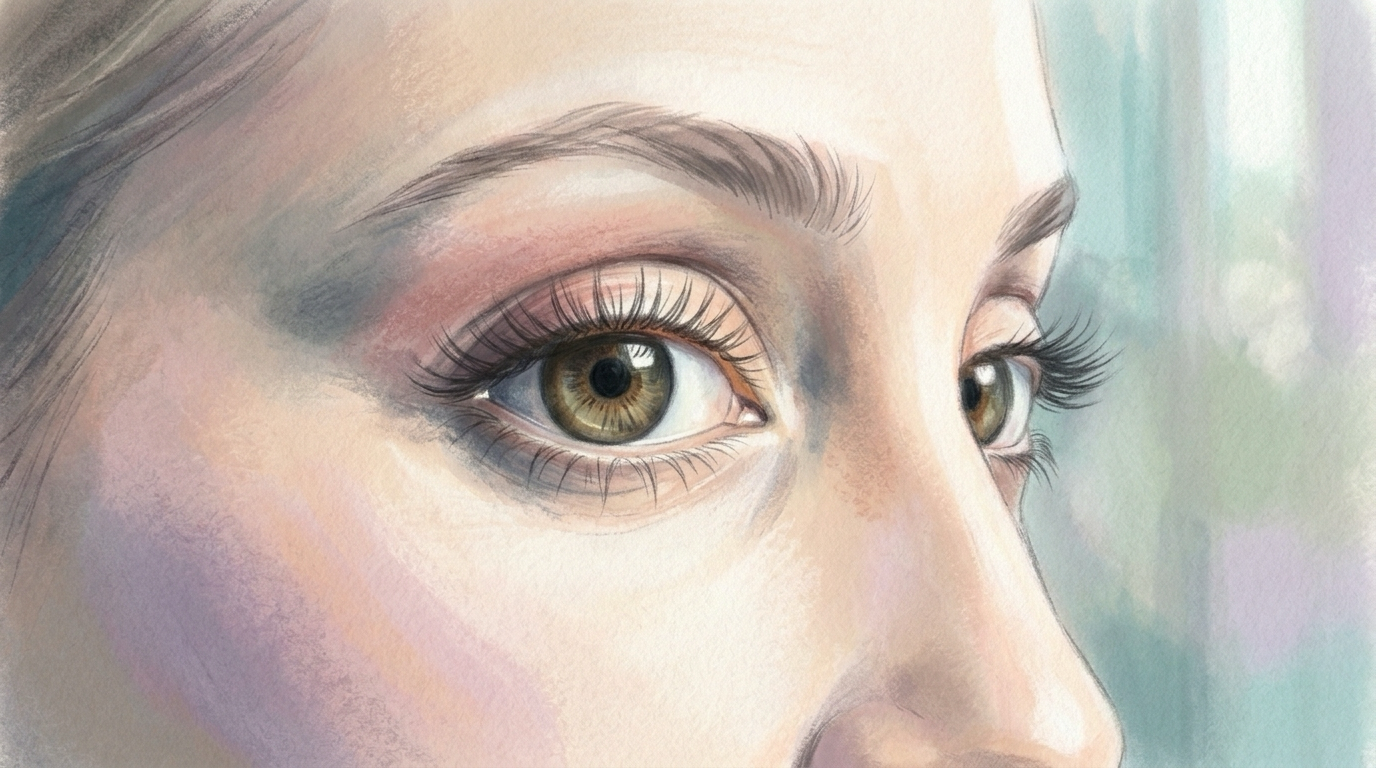
Illustration of an adult woman's eye in soft daylight.
Two points define the angle while the eyelids shape the outline
Canthal tilt is the angle of the line from the inner corner of the eye to the outer corner, measured against a level horizontal. The inner corner, where the lids meet beside the nose, is the medial canthus. The outer corner, toward the temple, is the lateral canthus. Only those two landmark points take part in the reading, and everything else on the face is ignored.
Three words describe the direction of that line. When the outer corner sits higher than the inner corner, the eye appears to lift toward the temple and the reading is positive. When the outer corner sits lower than the inner corner, the line slopes downward toward the temple and the reading is negative. When the two corners sit at roughly the same height within 1° of level, the Looksmax Scale tool used for the measurements in this article calls the reading neutral and prints the degrees next to the label because that boundary is a human convention.
What people usually mean when they call an eye downturned is the shape between those two points: an upper lid that sits low over the outer third of the eye, or a lower lid that dips toward the temple before turning up to meet the corner. Both change how the eye reads at a glance, and neither moves the two corners the tilt is measured from.
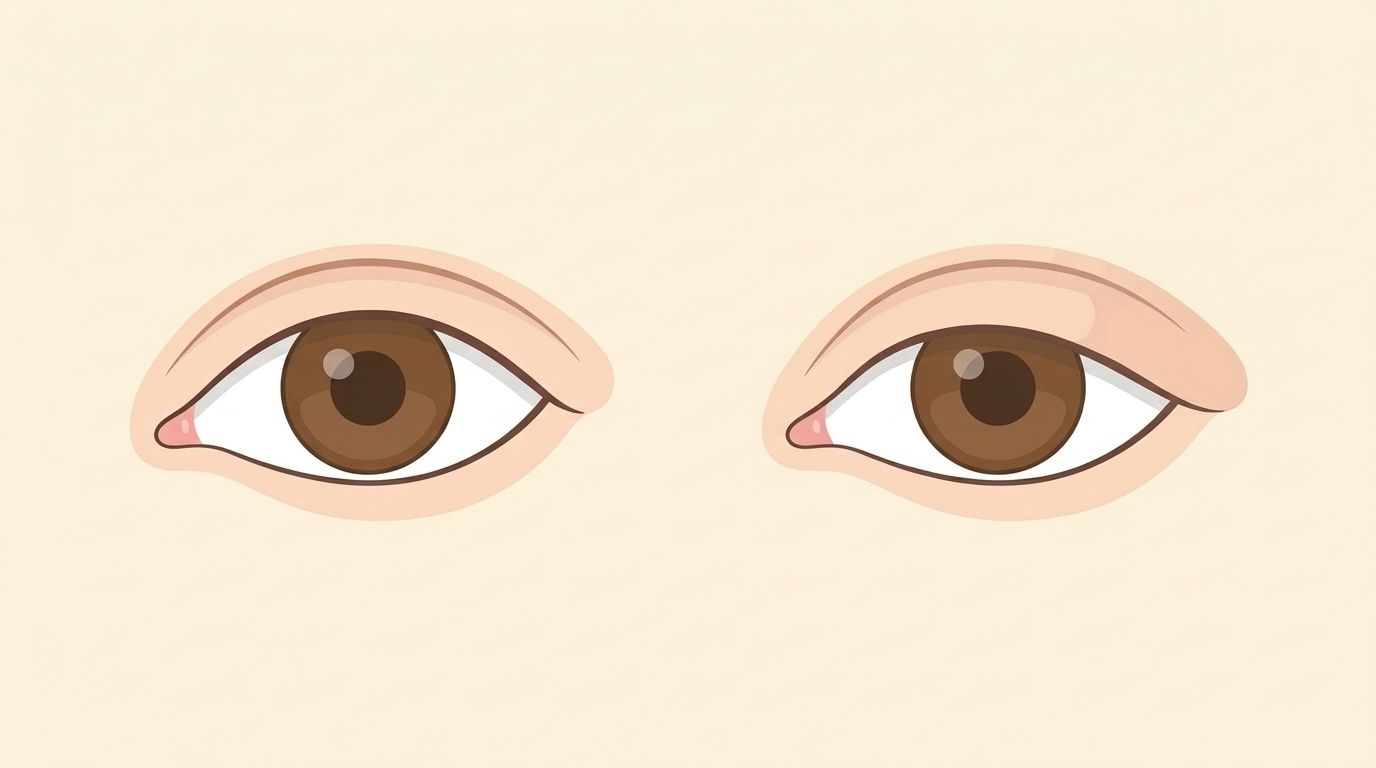
Illustration of two eye outlines side by side with different upper lid shapes.
Picture a drawn comparison where two eyes share the same two corner points and the same +5° line while only the curve of the eyelids between them differs. The tilt measurement sees the straight line in both and reads +5° twice.
A similar distinction applies to the informal term hunter eyes. In online looksmaxxing communities, hunter eyes usually describes a positive canthal tilt combined with deep-set eyes, a low and heavy brow, and little visible upper eyelid. Because a two-point measurement captures only the angle, it tells you which way your corners lean and by how many degrees while leaving shape and depth outside the number.
What eleven surgery-gallery photos and twenty-nine portraits showed
Real faces show the same split between corner height and eyelid curve. We ran eleven "before" photos from eyelid and canthoplasty surgery galleries through this tool, chosen because the eyes in them look downturned. Every one of the eleven photos measured a positive tilt, from +2.5° to +10.6°, with a median of +4.7°.
Comparing those readings with ordinary portraits puts them in context. Run on 29 official portrait photographs, this tool's average of both eyes had a median of +4.4°, with the middle half of the portraits between 3.3° and 5.3° and the full spread from −0.1° to 10.1° across about ten degrees. Commonly quoted reference ranges from QOVES, a web reference without peer review, put men at roughly 0° to +4° and women at roughly +2° to +8°. Judged by their corner lines, the downturned-looking eyes from the surgery galleries were ordinary.
The lids can still nudge the number. The tool places 478 landmark points on the face with Google's MediaPipe face landmark model, which runs in your browser, and takes the two points on the inner and outer corner of each eye. Because the landmark model places each corner partly from the shape of the lids around it, a heavy upper lid or a sloping lower lid can pull a reading down somewhat. Even so, all eleven surgery photos still measured a positive tilt on this tool.
How to inspect your own corner line and eyelid outline
Before trusting a tool, it helps to know how to measure your canthal tilt and check what your eyelids do beside the corner line. Start with a level, front-facing photo taken at eye level while looking straight at the camera. You can mark the inner and outer corners by hand and read the angle against a horizontal line, or let the browser tool place the points.
Before measuring, the tool levels the face along its own horizontal, found from twelve pairs of matching points on the cheekbones, jaw, mouth, nose, and brows, leaving out the eye corners. Using the edge of the photo instead would add about 4° to the difference between your two eyes' readings when the head is tilted sideways by just 2°. Across the 29 portraits, what remained between the two eyes after leveling averaged about 1°, which is within what one photo can resolve and too small for most people to see at conversational distance.

Illustration of an adult woman looking at her reflection in a bathroom mirror.
If your eyes look downturned to you and the tool reads a positive or neutral tilt, the lids are the likelier explanation. Your result draws the outline of both eyelids next to the corner line, so you can see whether your eyelids slope down while the corner line tilts up.
Why viral filters and cosmetic categories blur the two features
The mix-up between lid shape and corner tilt grew as the measurement moved into social media. By 2019, looksmax.org forum threads had made canthal tilt a fixed topic. In 2020, the fox-eye look drew criticism in The Stanford Daily for turning a feature widely associated with East Asian eyes into a trend. By 2023, a TikTok filter covered by HuffPost made the eye-corner line easy to screenshot, and Dexerto noted that people used the same filter as a guide for painting a straighter eyeliner wing.
Three categories of approach exist when people discuss changing eye tilt. This section describes what each one changes and stops there: it is not medical advice and does not recommend a procedure.
First, a makeup line extending upward from the outer corner changes where the eye appears to end, shifting the apparent tilt reversibly without touching anatomy. Second, brow procedures covered by the American Society of Plastic Surgeons raise the outer brow tissue above the eye while leaving the corners untouched, changing the impression of lift while the measured tilt moves little. Third, surgeries called canthoplasty and canthopexy reposition or tighten the tendon anchoring the outer corner; they are the only approaches that change the measured angle directly and carry eyelid surgery risks that require a qualified specialist. Muscle exercises do not move that tendon, and with age the outer corner tends to drop slightly as supporting tissue loosens.
As Ramtin Kassir, MD, a triple board-certified facial plastic and reconstructive surgeon, told Glamour, "Attractiveness is highly subjective and can vary significantly from person to person... There is no one-size-fits-all standard." Separating your eyelid outline from your corner line shows why a positive reading and a downturned look can appear together on an ordinary face.
Disclosure: This article was prepared for Looksmax Scale. Its Looksmax Scale canthal tilt test is the tool discussed here.
 Never miss a story from us, get weekly updates in your inbox.