
Operating in 65 countries, Delivery Hero takes care of millions of orders daily, covering food, groceries, and quick commerce. At present, Uber holds nearly 37% of Delivery Hero’s voting power, giving it a major voice in the global delivery race.
Delivery Hero is more than just a participant in the industry; it serves as a model for constructing global delivery platforms.
What makes a Delivery Hero Clone app profitable is the same thing that made Delivery Hero successful: a multi-revenue model running on top of a two-sided marketplace.
The short answer is yes. But if you want to build something similar, you need to understand the business model behind the success first.
Why the Delivery Hero Business Model Matters More Than the App
Most founders spend the first few weeks obsessing over the app. The design. The features. The onboarding flow.
That's understandable. But it's not what drives profit.
What makes a Delivery Hero clone app profitable is the same thing that made Delivery Hero successful: a multi-revenue model running on top of a two-sided marketplace.
Restaurants pay commission. Customers pay delivery fees. Vendors pay for visibility. Advertisers pay for placement. Subscribers pay for perks.
That's five revenue streams. Most clone apps launch with one or two and wonder why growth stalls.
What Revenue Streams Does a Delivery Hero Clone Script Offer?
#1. How Does Commission Pricing Work?
This is the foundation. For every order processed through the platform, you will receive a share, generally between 15% and 30% of the restaurant's earnings.
It's a simple calculation. 500 daily orders at an average basket of $20 with a 20% commission rate generate $2,000 a day. That's $60,000 a month from commission alone.
#2. How Delivery Fees Become a Key Revenue Driver
Customers pay delivery fees on almost every order. Even when they grumble about it, they still pay. A flat fee of $1.50 to $3.00 per order adds up quickly across thousands of daily transactions.
This revenue stream requires zero extra effort once the platform is live.
#3. How Do Subscription Plans Change the Numbers?
Delivery Hero's Everyday App strategy is built on this idea. When customers pay a monthly fee for free delivery or exclusive deals, they order more often. And platforms earn predictably regardless of daily order fluctuations.
A delivery hero clone script that supports subscription tiers has a measurable edge over one that doesn't. Recurring revenue is simply more stable than transaction-by-transaction income.
How Soon Can You Break Even With a Delivery Hero Clone?
With a delivery hero clone script, a well-managed niche delivery platform can realistically break even between months 10 and 18.
It all actually depends on how quickly you onboard restaurants, the rate at which repeat orders increase, and whether you activate multiple revenue streams from the very first day.
Geographic focus helps too. Starting in one city, owning it, then expanding is consistently faster to profitability than launching broadly with thin coverage everywhere.
Conclusion
The delivery market is not slowing down. Delivery Hero's own 2025 results showed Quick Commerce growing over 30% year on year. The demand is there.
What separates a profitable Delivery Hero clone from an unprofitable one isn't the technology. It's the revenue strategy behind it and the discipline to execute in a focused market before trying to scale everywhere.
Launching your platform with the Delivery Hero clone script is the easy part. The business decisions around it are where profit actually lives.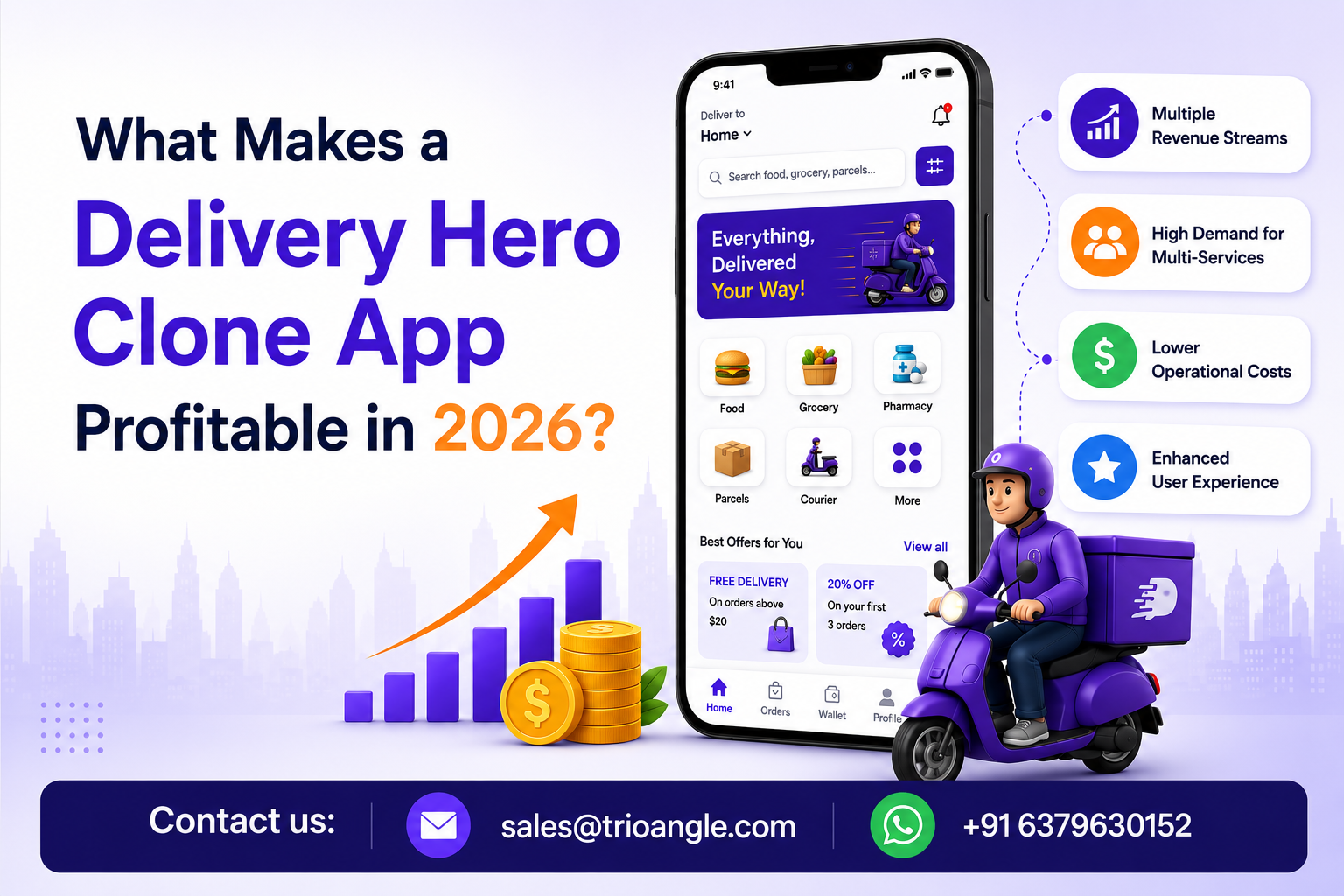
 Never miss a story from us, get weekly updates in your inbox.