
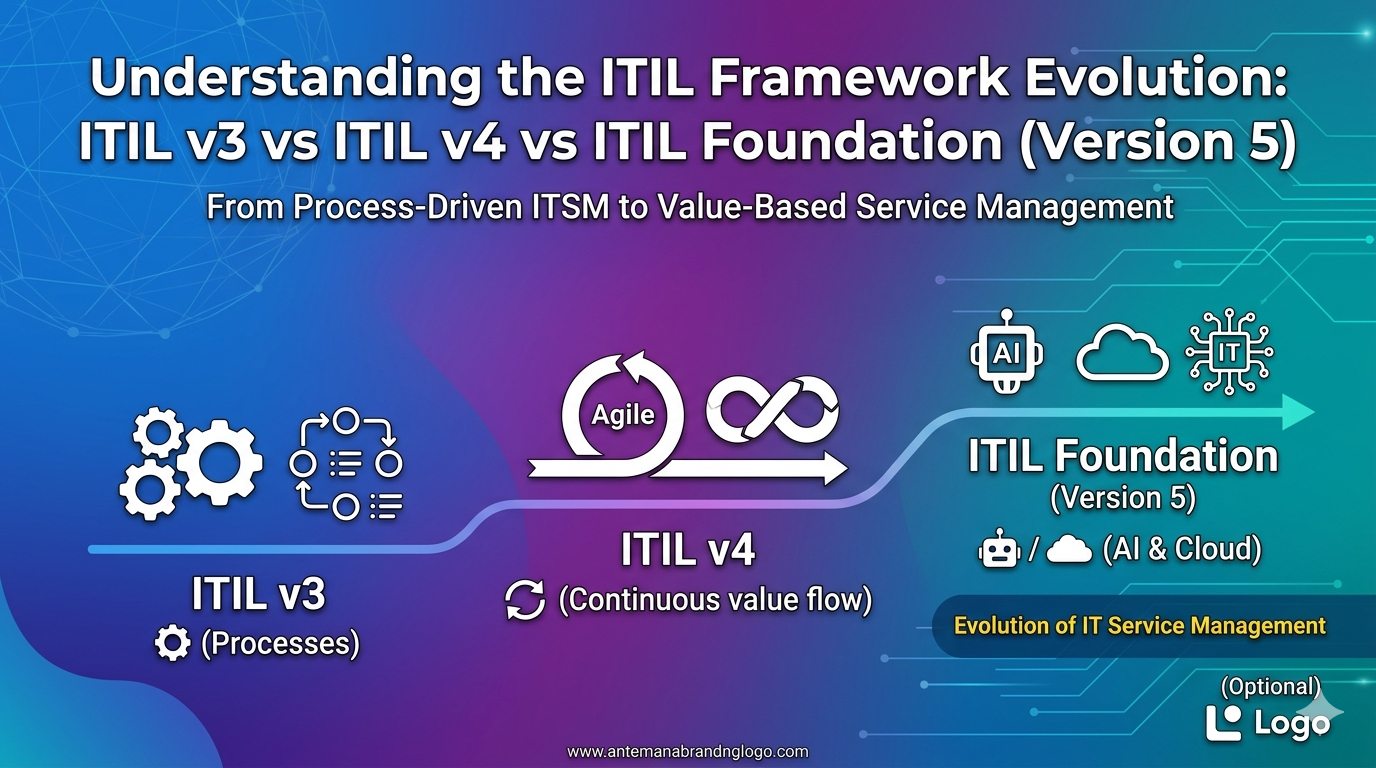
The IT service management (ITSM) landscape has undergone significant transformation over the years, and the ITIL framework has evolved alongside it. From a process-heavy structure in earlier versions to a more flexible, value-driven approach today, ITIL continues to adapt to modern business needs. Understanding this evolution—from ITIL v3 to ITIL v4 and now the latest version—is essential for professionals who want to stay relevant in today’s dynamic IT environment.
The Foundation: ITIL v3 and Its Process-Oriented Approach
ITIL v3, introduced in 2007 and updated in 2011, was built around a lifecycle-based model of IT service management. It structured IT services into five core stages:
Service Strategy
Service Design
Service Transition
Service Operation
Continual Service Improvement
This version focused heavily on standardization, documentation, and process optimization. Organizations adopted ITIL v3 to improve service quality, reduce costs, and align IT services with business objectives.
While ITIL v3 brought clarity and structure, it had some limitations. The rigid process-based model sometimes struggled to keep up with rapidly changing technologies, especially with the rise of cloud computing, DevOps, and Agile methodologies. Businesses needed more flexibility, faster delivery, and continuous integration—areas where ITIL v3 showed gaps.
The Shift to ITIL v4: A Modern, Agile-Friendly Framework
To address these challenges, ITIL v4 was launched in 2019 as a major overhaul of the framework. Instead of focusing solely on processes, ITIL v4 introduced a holistic and flexible approach centered around value creation.
One of the most important changes was the introduction of the Service Value System (SVS). This system ensures that all components of an organization work together to create value. It includes:
Guiding Principles
Governance
Service Value Chain
Practices
Continual Improvement
The Service Value Chain replaced the rigid lifecycle model of ITIL v3, offering a more dynamic and adaptable way to manage services. It supports activities like planning, improving, engaging, designing, transitioning, obtaining/building, and delivering/supporting services.
Another major shift in ITIL v4 was the replacement of “processes” with “practices.” These practices are more flexible and can be tailored to different organizational needs. ITIL v4 defines 34 practices, including:
Incident Management
Change Enablement
Problem Management
Service Desk
ITIL v4 also integrates modern methodologies such as Agile, DevOps, and Lean, making it highly relevant in today’s fast-paced digital environment. This alignment allows organizations to deliver value faster while maintaining stability and control.
The Latest Evolution: ITIL Foundation (Version 5)
The latest version, often referred to as ITIL Foundation (Version 5), builds upon the strong foundation of ITIL v4 while refining and updating concepts to meet current industry demands. It emphasizes:
Digital transformation and automation
Customer-centric service delivery
Integration with emerging technologies like AI and cloud computing
Greater focus on value co-creation between service providers and consumers
This version is designed to be more practical, user-friendly, and aligned with real-world applications. It simplifies complex concepts while maintaining the core principles of ITIL.
The latest version also enhances learning by focusing on real-life scenarios, case studies, and practical implementation, making it easier for professionals to apply knowledge in their day-to-day roles.
Key Differences: ITIL v3 vs ITIL v4 vs ITIL Foundation (Version 5)
Understanding the differences between these versions helps highlight the evolution:
1. Approach
ITIL v3: Process-driven
ITIL v4: Value-driven and flexible
Latest Version: Value-focused with real-world application and digital alignment
2. Structure
ITIL v3: Lifecycle model
ITIL v4: Service Value System (SVS)
Latest Version: Enhanced SVS with practical adaptability
3. Focus Areas
ITIL v3: Standardization and control
ITIL v4: Collaboration, agility, and integration
Latest Version: Digital transformation, automation, and user experience
4. Terminology
ITIL v3: Processes
ITIL v4: Practices
Latest Version: Practices with enhanced usability and real-world context
Why This Evolution Matters
The evolution of ITIL reflects the changing needs of businesses and technology landscapes. Organizations today require:
Faster service delivery
Better customer experience
Continuous improvement
Integration with modern tools and frameworks
ITIL’s transition from v3 to v4 and beyond ensures that it remains relevant, adaptable, and aligned with current industry trends.
For professionals, understanding this evolution is crucial. It not only helps in mastering IT service management but also ensures that skills remain up-to-date and valuable in the job market.
How ITIL V4 Certification and ITIL Foundation (Version 5) Enhance Your Career
Earning certifications in ITIL v4 and the latest ITIL Foundation (Version 5) can significantly boost your career prospects. These certifications validate your understanding of modern IT service management practices and demonstrate your ability to adapt to evolving business environments.
With organizations increasingly adopting Agile, DevOps, and digital transformation strategies, professionals with updated ITIL knowledge are in high demand. Certification helps you:
Gain industry-recognized credibility
Improve your job opportunities in ITSM roles
Increase your earning potential
Develop skills in service delivery, problem-solving, and process improvement
Stand out in competitive job markets
Roles such as IT Service Manager, Service Desk Analyst, ITSM Consultant, and Change Manager often prefer or require ITIL-certified professionals. Moreover, the latest version equips you with practical knowledge that can be directly applied in real-world scenarios, making you more effective in your role.
Final Thoughts
The journey from ITIL v3 to ITIL v4 and the latest version showcases a clear shift from rigid processes to flexible, value-driven practices. This evolution ensures that ITIL remains a powerful framework for managing IT services in a rapidly changing digital world.
For professionals and organizations alike, staying updated with the latest version is not just beneficial—it’s essential. By embracing modern principles and aligning with current trends, ITIL continues to be a cornerstone of effective IT service management.
 Never miss a story from us, get weekly updates in your inbox.