
Most cues don't break. They bend, slowly, while nobody is watching. A cue leaned against a wall for a month picks up a curve you can't see but will definitely feel, usually on the one shot that mattered.
Why Does Cue Storage Matter More Than Most Players Think?
A cue is a long, thin piece of wood under constant pressure from gravity and humidity. Treat it carelessly and it changes shape. Treat it well, and a good cue can outlast the table it was bought with. Most players spend hours choosing a cue and about four seconds deciding where to put it afterwards. Storage is the difference, and it takes far less effort than people assume.
What Happens When Cues Are Stored Badly?
Picture a typical evening. The game ends, someone leans both cues in the corner beside the table, and they stay there until the weekend. Week after week, the weight rests unevenly on the tip and joint. By monsoon, the shaft has soaked up moisture on one side. Then a guest lines up a simple pot, the ball rolls off line, and everyone blames the cloth.
Laying cues flat on the table isn't much better. They roll. They get knocked onto the floor, and the ferrules chip. Tossing them in a cupboard usually ends with a dented tip or a scratched butt. None of this is dramatic. It just adds up.
Upright Storage Keeps Every Shot Honest!
Vertical storage helps to spread the load evenly along the length of the cue. Nothing is pushing on the side of the shaft, so it has no reason to bend. The tip does not contact hard surfaces. And each cue has its own slot; no one snatches the wrong one or knocks over three trying to reach for theirs.
Plus, there's a practical plus. You notice a worn tip before it ruins a frame. Cues kept upright and visible are checked more often. A billiard cue rack makes maintenance a sight you see every time you walk by, not a chore.
How the Linea Billiard Cue Stand Earns Its Place in the Room
Function comes first, but nobody wants a stand that looks borrowed from a pub. The Linea was designed as a piece of furniture that happens to hold cues. It stands on its own, so there's no drilling into a wall you may want to repaint later. Placed beside a pool or snooker table, it reads as part of the same set.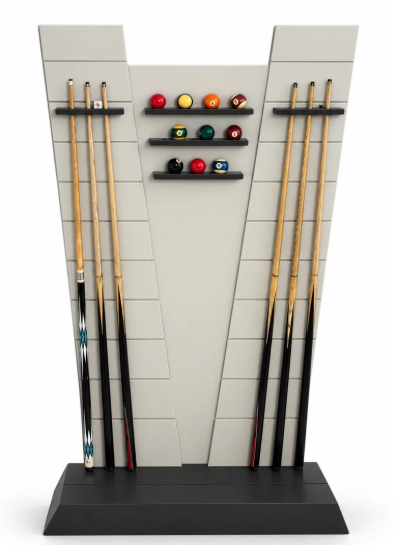
Where Should Cue Balls Live When the Game Is Over?
Right next to the cues. That's the honest answer. Players lose more time hunting for the ball set than they spend racking it. When the cue balls end up in a drawer in one room and the chalk in another, the first ten minutes of every session go to searching.
Keep everything in one zone, and let the stand mark that zone. Cues go up, the ball set stays in its case or tray nearby, and the next game starts the moment someone walks in. If you want ball storage built into the piece itself, raise it with the design team at the commissioning stage.
Made to Order, Down to the Last Finish!
Every Linea is built after you order it. You choose the finishes and detailing to match your table, flooring, or bar, or you commission a fully bespoke specification. Veneers, stone, and leather each carry their own grain and tonal shifts. That variation is proof the material is genuine, and it's why no two ARGMAC pieces turn out identical.
Delivery runs across India in a protective wooden crate. The team handles installation and levelling, quoted according to your location and site. After-sales service and replacement parts are covered too, which matters for something you plan to keep for decades.
How to Place and Care for Your Cue Stand
Placement decides whether a stand actually gets used. Put it within two or three steps of the table, on the side where players naturally walk, and away from direct sunlight and AC vents. Strong sun fades finishes. Cold air blowing straight onto wood dries it unevenly. Avoid the spot directly behind the shooting line, or someone's backswing will find it eventually. If the game room shares space with a home bar; keep the stand on the playing side so drinks and cues never cross paths.
Most of the care is common sense. Chalk dust and hand oil accumulate quickly, so wipe each cue with a dry cloth before returning it. Dust the stand with a soft, slightly damp cloth. Avoid harsh cleaners on veneer or leather. Check that each cue is lying flat in its rack and not at an angle. Once a season, check tips and ferrules as you line them up in front of you. The same routine is used for your cue balls; a quick wipe after play will keep them rolling true and keep chalk off the cloth.
FAQs
Is a billiard cue stand necessary if I only play occasionally?
Yes, arguably more so. Cues that sit unused for long stretches are the ones most likely to warp, because nobody notices them leaning in a corner for months. Occasional players also tend to keep guest cues, which need a proper home even more.
Does the Linea need to be mounted on a wall?
No. It stands on its own, so it can move with you if you rearrange the room.
Can the finish be matched to my existing table?
It can. Every piece is made to order, with finishes and detailing chosen by you or specified fully bespoke with the design team.
Is installation available outside Delhi?
Yes. Professional installation and levelling are available across India, with quotes based on location, distance, and site requirements.
Conclusion
Good cues deserve a proper home, and the fix is simpler than most players expect. Upright storage stops warping, protects tips, and keeps your cue balls and cues together so every game starts on time. A well-made billiard cue stand also does something a wall corner never will. It makes the game room feel finished.
See the Linea Cue Stand in detail, or browse Argmac for tables and accessories built to sit alongside it.
 Never miss a story from us, get weekly updates in your inbox.