
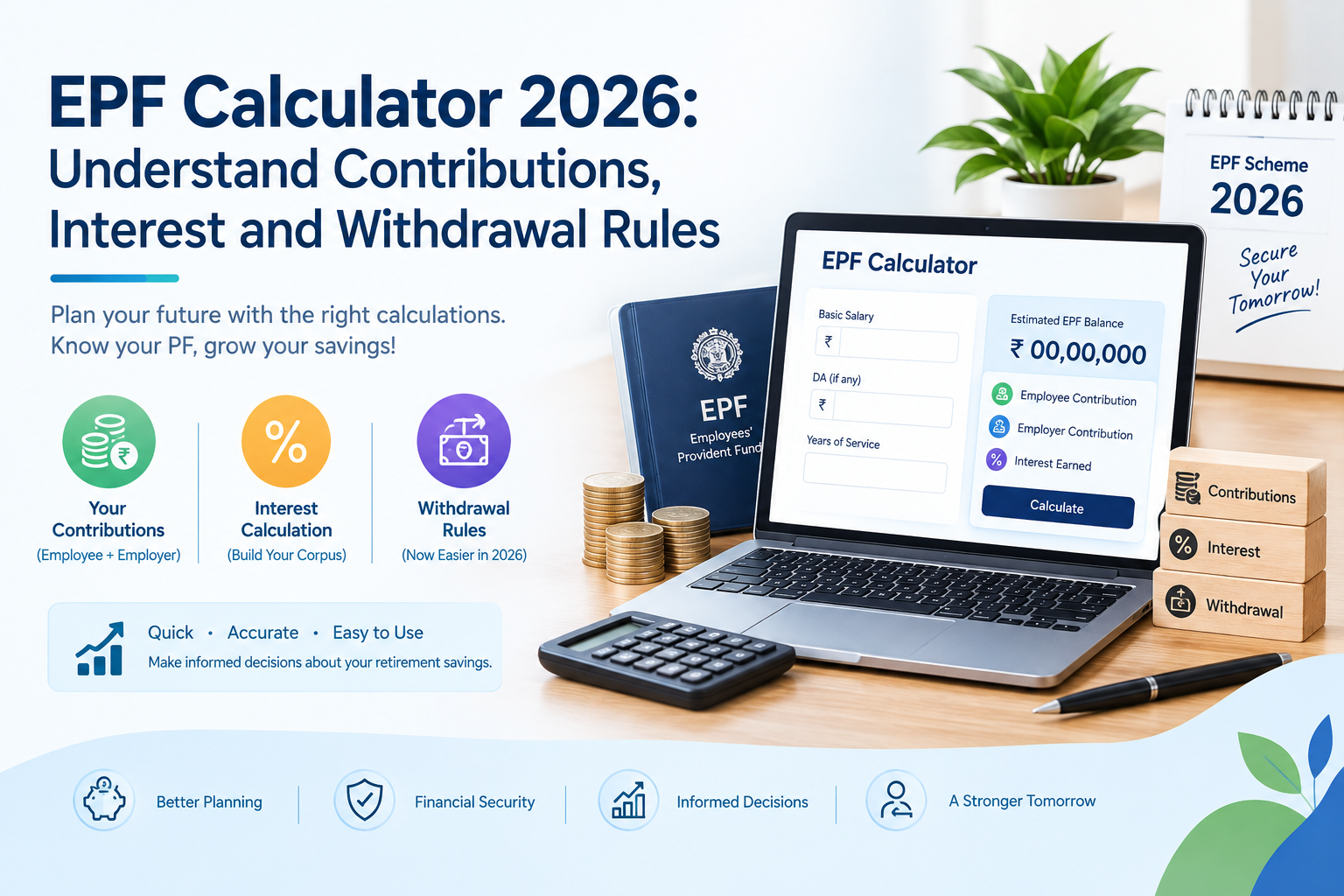
Planning your retirement savings becomes easier when you understand how your Employee Provident Fund (EPF) contribution grows over time. An EPF Calculator can help employees estimate their provident fund balance by considering salary, employee and employer contributions, interest, and the investment period.
With important changes introduced through the EPF Scheme 2026 and fresh developments around the EPF wage ceiling, understanding how calculations work has become even more relevant for salaried employees.
What Is an EPF Calculator?
An EPF Calculator is an online financial tool that estimates how much money an employee may accumulate in their provident fund over a selected period. Instead of manually calculating monthly contributions and projected interest, employees can enter relevant salary details and receive an estimated future balance.
Typically, the calculation considers basic salary, dearness allowance where applicable, employee contribution, employer contribution, current EPF balance, expected interest rate, and the remaining service period.
The result is an estimate rather than a guaranteed final balance because actual EPF interest credits and contribution amounts depend on applicable rules and account activity.
How Does EPF Contribution Work?
EPF is designed to create long-term retirement savings through regular contributions. Under the EPF Scheme 2026, the statutory contribution structure broadly continues with a 12% contribution from the employee and employer, subject to the applicable wage ceiling and rules.
For example, if the applicable EPF wage is ₹15,000 per month, a 12% employee contribution would be ₹1,800. The employer contribution is also structured around the applicable statutory provisions, with part of the employer's contribution going toward the pension component where applicable.
However, employees should not assume that every salary component is automatically included in the EPF calculation. The calculation depends on the definition of wages and the employee's specific circumstances.
Why Use an EPF Calculator in 2026?
The year 2026 has brought significant developments to India's provident fund framework. The Employees' Provident Funds Scheme, 2026 replaced the earlier framework and introduced changes to withdrawal processes, digital compliance, and other operational provisions.
Another major development reported on September 16, 2026, is the Union Cabinet's approval of a plan to increase the EPF wage ceiling from ₹15,000 to ₹25,000. The practical implementation and applicable rules should be checked against official notifications before using the proposed ceiling in payroll calculations.
These developments make it useful for employees and HR teams to regularly review their PF calculations rather than relying on outdated assumptions.
Read also: 7 Best Shift Management Software for Businesses in India
How to Calculate EPF Interest
EPF interest is generally calculated on the monthly running balance, while the interest rate is declared for the relevant financial year.
For FY 2025–26, the EPF interest rate has been reported as 8.25%.
A simplified example can help explain the concept. Suppose an employee contributes ₹1,800 every month and the employer also makes an applicable contribution. Over several years, the accumulated contributions can grow substantially because the account earns interest.
An EPF Calculator makes this process easier by applying the relevant inputs and projecting the potential accumulated amount. Employees can use such estimates to understand how regular contributions may contribute to their long-term retirement corpus.
The actual balance may differ from a calculator's estimate because salary, contribution amounts, interest rates, employment periods, withdrawals, and applicable regulations can change.
EPF Withdrawal Rules in 2026
Withdrawal rules are another important reason to understand your EPF account. The EPF Scheme 2026 simplified several advance-withdrawal categories by grouping them into broader areas such as essential needs, housing-related needs, and special circumstances.
The new framework also changed the rules around final settlement after leaving employment. Reports on the 2026 scheme indicate that employees generally face a longer waiting period before premature final settlement after leaving a job, while eligible partial withdrawals continue under specified conditions.
Employees should therefore distinguish between:
- Partial or advance withdrawal
- Final EPF settlement
- Pension-related benefits
- Transfer of EPF balance after changing jobs
Understanding these differences can help employees avoid unnecessary withdrawals from their retirement savings.
Role of Payroll Software in EPF Management
For employers, calculating and maintaining accurate PF information manually can become difficult as the workforce grows. Payroll Software can help automate salary calculations, deductions, employee contributions, pay slips, and payroll records.
When payroll and HR processes are connected, organizations can reduce repetitive calculations and maintain more consistent employee records. Payroll teams can also use automated workflows to support timely salary processing and statutory compliance.
Employees benefit indirectly because accurate payroll records make it easier to understand deductions shown on their pay slips and compare them with their EPF account information.
EPF Calculator vs Other Salary Calculators
Employees often use multiple financial calculators because different components of compensation serve different purposes.
A Gratuity Calculator helps estimate the gratuity amount an eligible employee may receive based on applicable salary and service conditions. It is particularly useful when employees are planning long-term employment benefits.
Similarly, an HRA Calculator can help employees estimate eligible House Rent Allowance-related tax benefits based on salary, rent, and other applicable conditions.
An EPF calculation focuses primarily on provident fund contributions and accumulated retirement savings. Using these calculators together can give employees a broader understanding of their salary structure and long-term benefits.
Trending EPF Developments to Watch in 2026
Several developments are shaping the EPF landscape this year.
1. New EPF Scheme 2026
The new EPF framework has modernized the legal and operational structure while retaining key contribution provisions.
2. Proposed Higher Wage Ceiling
The Cabinet approved a plan on September 16, 2026, to raise the EPF wage ceiling from ₹15,000 to ₹25,000. Employees and employers should wait for the applicable implementation details and official notifications when calculating contributions under the new ceiling.
3. Digital EPFO Services
EPFO has continued expanding digital services. Its upgraded systems have consolidated member information and introduced improvements to claim processing and online services.
4. Easier PF Transfers
Digital improvements have also supported online PF transfers when employees change jobs, helping members consolidate their retirement savings.
How Employees Can Plan Their EPF Savings
Employees should regularly check their salary structure, monthly PF contribution, employer contribution, EPF balance, and credited interest. Maintaining updated KYC and employment information can also make account-related services easier to manage.
Instead of viewing EPF only as a monthly salary deduction, employees can consider it as part of their overall retirement strategy. Combining EPF savings with other eligible investments and benefits can provide a more complete picture of long-term financial planning.
A Gratuity Calculator and HRA Calculator can also be useful alongside an EPF calculation when reviewing total employee benefits and salary components.
Conclusion:
An EPF Calculator provides a convenient way to estimate provident fund contributions, interest accumulation, and potential retirement savings. With the introduction of the EPF Scheme 2026 and ongoing changes to digital services and contribution-related rules, employees should keep their calculations aligned with the latest applicable regulations.
For businesses, accurate payroll processing is equally important because EPF deductions and employee records form an essential part of workforce administration. Savvy HRMS can help organizations manage payroll and broader HR processes through a structured digital platform, supporting more efficient workforce management.
As EPF rules continue to evolve in 2026, employees and employers should rely on current official notifications when making final contribution, withdrawal, or retirement-planning decisions.
 Never miss a story from us, get weekly updates in your inbox.