
Digital transformation is reshaping how businesses operate, serve customers, and compete in the UAE. However, adopting new technology without a clear strategy can lead to unnecessary costs, security gaps, and systems that do not support business goals. Technology Advisory services UAE help organizations make informed technology decisions by connecting business objectives with practical IT strategies. From Technology Advisory Services and Technology Advisory consulting to Cloud migration services in the UAE, businesses can use expert guidance to build a more efficient, scalable, and future-ready technology environment.
1. What Is Technology Advisory and Why Does It Matter?
Technology advisory is a strategic service that helps businesses evaluate their current technology environment and determine how technology can better support their objectives.
Instead of focusing only on individual software or hardware solutions, technology advisors look at the bigger picture, including:
Business goals and growth plans
Existing IT infrastructure
Digital processes and applications
Cybersecurity requirements
Data and analytics capabilities
Cloud adoption
Technology costs and risks
For UAE businesses operating in a competitive and rapidly developing market, this broader perspective can make technology investments more purposeful.
Connecting technology with business goals
A strong technology strategy should answer a simple question: How will this technology help the business perform better?
Technology advisory helps decision-makers evaluate potential investments based on business value rather than following technology trends simply because they are popular.
2. How Technology Advisory Services UAE Support Digital Growth
Digital growth requires more than purchasing new technology. Businesses need systems that can scale as their operations, customers, and workforce expand.
Technology Advisory Services can help organizations identify opportunities to improve processes, integrate systems, and introduce digital capabilities.
For example, a growing company may discover that disconnected systems are causing duplicate data entry and delays. An advisory assessment could identify opportunities for application integration and workflow automation.
The result can be a technology environment that is easier to manage and better aligned with operational requirements.
3. Creating a Technology Roadmap for Long-Term Growth
One of the most valuable outcomes of Technology Advisory consulting is a practical technology roadmap.
A roadmap provides a structured plan for moving from the current technology environment toward a desired future state.
What a technology roadmap should include
A useful roadmap can cover:
Current-state assessment — Understand existing systems, processes, and limitations.
Business priorities — Identify the technology requirements supporting growth.
Gap analysis — Determine where current capabilities fall short.
Technology priorities — Rank initiatives according to business value, risk, and feasibility.
Implementation timeline — Establish realistic phases and milestones.
Investment planning — Estimate resources and costs required for implementation.
Performance measures — Define how progress will be evaluated.
This approach helps organizations avoid making disconnected technology decisions and instead build toward a clear long-term objective.
4. The Role of Cloud Migration in Digital Transformation
Cloud technology has become a key component of modern IT strategies. However, moving applications and data to the cloud requires careful planning.
Cloud migration services in the UAE can support organizations through activities such as environment assessment, migration planning, workload prioritization, security considerations, and post-migration optimization.
Benefits of a well-planned cloud strategy
Depending on the business and its technology environment, cloud adoption can provide:
Greater scalability
Flexible access to computing resources
Improved collaboration
More efficient infrastructure management
Better support for remote operations
Opportunities to modernize legacy applications
Businesses should avoid assuming that every workload needs to move to the cloud. Technology advisors can help determine which applications are suitable for migration and whether a public, private, hybrid, or other approach fits the organization’s requirements.
5. Improving Technology Investment Decisions
Technology investments can become expensive when organizations select solutions without properly understanding their requirements.
Technology advisory provides a structured way to evaluate potential investments.
A practical evaluation framework
Before selecting a technology solution, businesses should consider:
Does it solve a defined business problem?
Can it integrate with existing systems?
Is it scalable?
What are the implementation and ongoing costs?
What security controls are required?
Can employees use it effectively?
What measurable business outcome should it deliver?
This evaluation can reduce the risk of investing in technology that looks impressive but provides limited practical value.
6. Common Technology Advisory Challenges and Mistakes
Businesses can encounter several challenges when developing a technology strategy.
Focusing on technology instead of business needs
Adopting technology simply because it is new can create unnecessary complexity. Every technology initiative should have a clear business purpose.
Ignoring legacy systems
Older applications may still support important operations. Replacing everything immediately can create unnecessary disruption. A phased modernization approach may be more appropriate.
Underestimating cybersecurity
Digital transformation can introduce new vulnerabilities. Security should be considered during technology planning rather than added after implementation.
Poor change management
Even well-designed technology can fail to deliver results if employees do not understand how to use it. Training, communication, and stakeholder involvement should be part of the implementation plan.
7. Measuring the Success of Technology Advisory
Digital growth should be measurable. Businesses should establish performance indicators before implementing major technology initiatives.
Depending on the project, useful metrics may include:
Reduction in operational costs
Process completion time
System availability
Employee productivity
Customer response times
Technology adoption rates
Number of manual processes eliminated
Return on technology investment
Regular reviews allow leadership teams to determine whether technology initiatives are delivering the expected outcomes.
Reviewing progress regularly
Technology strategies should not remain unchanged for years. Business priorities, customer expectations, security risks, and available technologies continue to evolve.
A quarterly or periodic technology review can help organizations adjust their roadmap when necessary.
8. Next Steps for Building a Future-Ready Technology Strategy
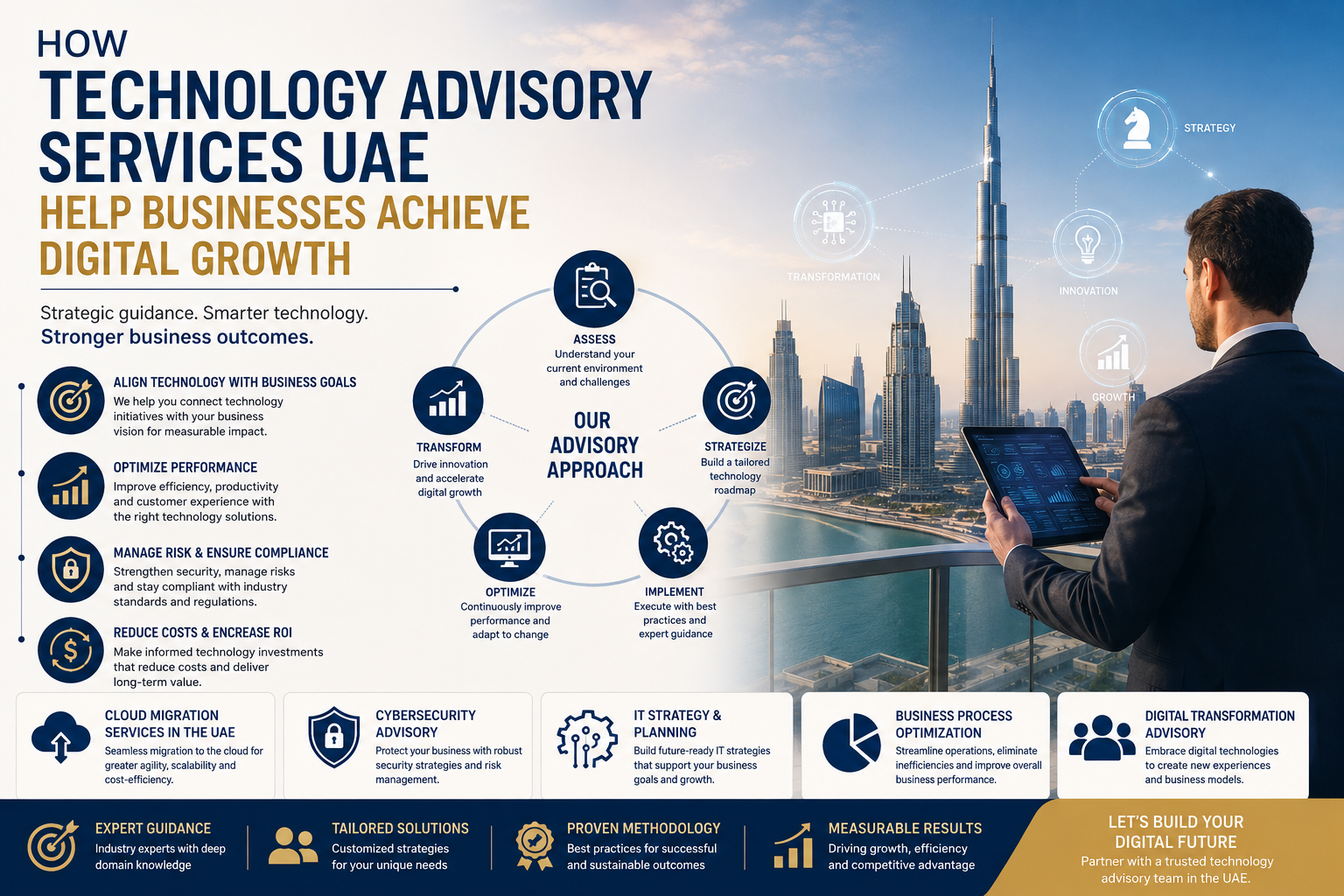
Businesses ready to improve their digital capabilities can begin with a structured approach:
Assess the current technology environment.
Identify operational and customer-facing challenges.
Define measurable business objectives.
Identify technology gaps and risks.
Prioritize high-value initiatives.
Develop a phased technology roadmap.
Evaluate cloud and digital modernization opportunities.
Include cybersecurity and compliance requirements.
Train employees and manage organizational change.
Measure results and continuously improve.
For organizations with complex systems or limited internal expertise, working with an experienced technology advisory partner can provide additional strategic guidance.
Conclusion
Technology can be a powerful driver of business growth, but successful digital transformation requires more than adopting the latest tools. Organizations need a clear strategy that connects technology investments with measurable business objectives.
From strategic planning and Technology Advisory consulting to cloud modernization and Cloud migration services in the UAE, the right advisory approach can help businesses improve efficiency, manage technology risks, and prepare for future opportunities.
For UAE organizations planning their next stage of digital growth, Technology Advisory services UAE can provide the structured guidance needed to turn technology investments into practical business outcomes. The best starting point is to assess the current environment, identify the highest-value opportunities, and build a realistic roadmap for sustainable digital growth.
 Never miss a story from us, get weekly updates in your inbox.