
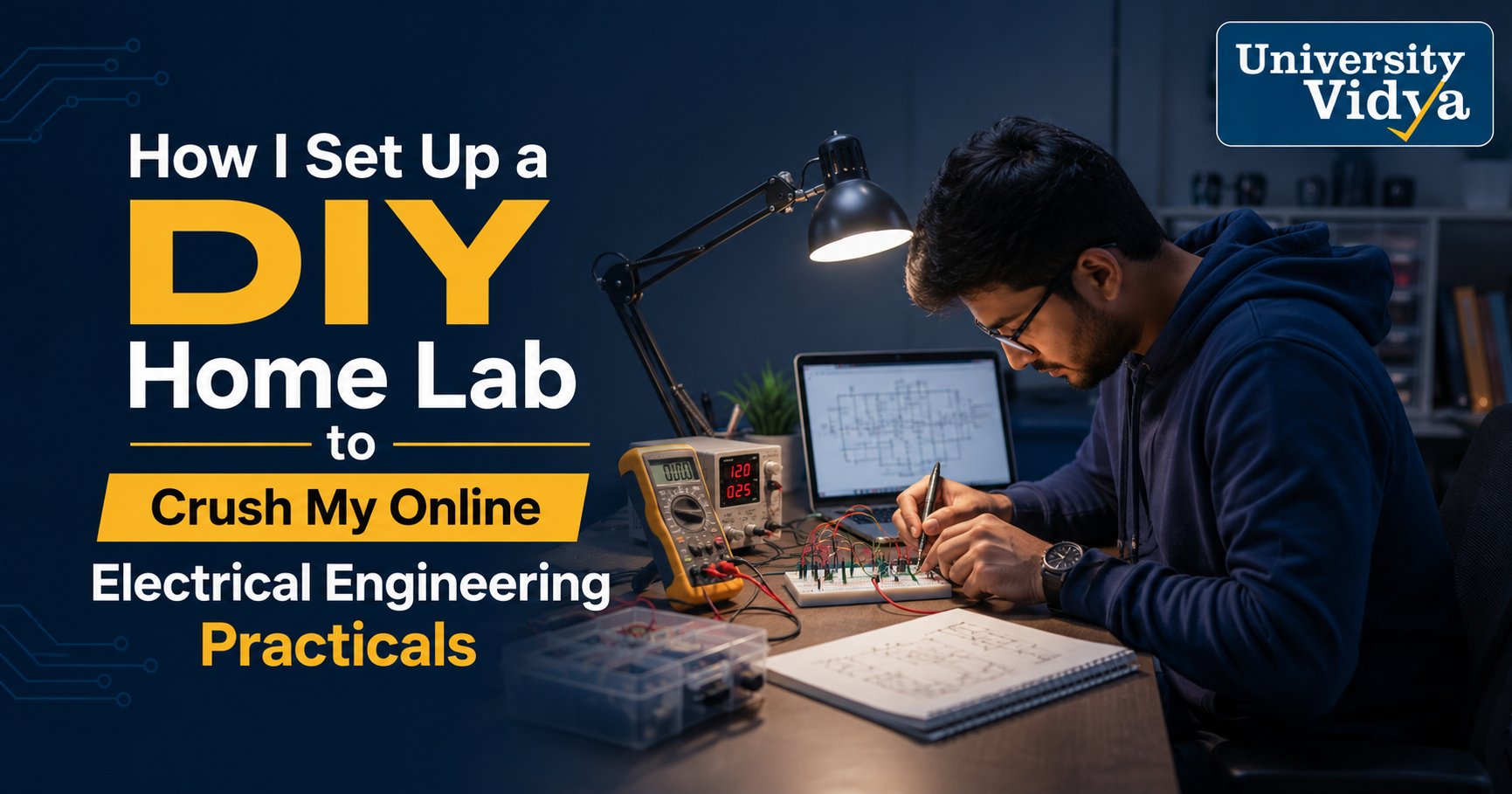
When I enrolled in my distance learning program, my biggest fear was not the complex math or the late-night study sessions. It was the total lack of a physical university laboratory. How could I truly master Online Electrical Engineering without burning my fingers on a soldering iron or stripping real wires?
I quickly realized that reading about circuit theorems in a textbook is vastly different from actually building them in reality. A screen simply cannot replicate the tangible feedback of hardware. In this post, I will share exactly how I transformed a corner of my garage into a fully functional DIY home lab.
You will learn what gear to prioritize, where my initial study habits failed miserably, and how hands-on practice can skyrocket your grades. If you are worried about missing out on practical skills during your distance learning journey, this guide is for you.
The Initial Struggle: Relying Solely on Virtual Simulations
During my first semester, I tried to get by using only digital circuit simulators to complete my coursework. I thought I was saving space and hassle by doing everything cleanly on my laptop. This turned out to be a massive mistake that almost derailed my studies.
When it came time for my first live practical assessment over a webcam, I panicked. My simulated circuits had always worked perfectly, but the real world is full of imperfect components and loose physical connections. I failed that first practical assignment miserably because I did not know how to physically troubleshoot.
That failure was the painful wake-up call I desperately needed. I had to stop hiding behind a pristine digital screen and start getting my hands dirty with actual hardware.
Building the Foundation: Essential Gear for Your Home Lab
I did not have a massive budget, so I started with the absolute bare essentials. A reliable digital multimeter, a few large breadboards, and a starter kit of resistors and capacitors became my best friends. I cleared out a small, sturdy workbench in my garage to serve exclusively as my experiment station.
At first, I struggled with incredibly simple tasks, like reading resistor color codes quickly or stripping wires without breaking the core. However, dedicating just one hour a day to physical practice built up my muscle memory. Soon, I was diagnosing short circuits and tracing voltage drops faster than I ever could on a computer.
I also invested in a good soldering iron and safety goggles, which changed the game for permanent projects. Learning to solder cleanly taught me patience and precision, skills that are highly valued in the actual engineering workforce.
Expanding Beyond the Basics: Connecting the Disciplines
As my coursework advanced, so did the complexity of my DIY laboratory. I realized that modern engineering is highly interconnected, requiring a broad understanding of multiple systems working together. To tackle my advanced modules, I saved up for a digital oscilloscope and a programmable microcontroller kit.
This upgraded setup did not just help with my core subjects; it gave me a massive edge in broader topics. For instance, when I took an Online Electrical and Electronics Engineering Course module, having a physical oscilloscope made visualizing signal processing incredibly intuitive. I could actually see the waveforms I was learning about in real-time, rather than just trusting a textbook diagram.
My lab also proved invaluable when I started exploring advanced communication protocols and radio frequencies. The hands-on experience perfectly complemented the complex theories taught in an Online Electronics and COmmunication Engineering syllabus. By physically wiring small transceivers, the abstract concepts of signal modulation finally made complete sense to me.
Overcoming Setup Challenges and Failures
Building this lab was certainly not without its fair share of headaches. I blew up more than a few LEDs and accidentally fried a rather expensive temperature sensor by applying the wrong voltage. These mistakes were incredibly frustrating in the moment, but they taught me the critical importance of reading datasheets meticulously.
If you are setting up your own space, always triple-check your power supply ratings before flipping the switch. Learning to fail safely at home made me vastly more confident during my live virtual assessments and eventual job interviews.
How a DIY Mindset Applies to Every Engineering Field
The hands-on problem-solving skills I gained at my workbench translated beautifully to my professional career. I learned that taking ownership of your practical education is the ultimate secret to thriving in distance learning. This proactive approach is certainly not limited to just wiring circuits.
I have spoken to several peers who applied this exact same DIY mindset to entirely different academic fields. A friend pursuing an Online Chemical Engineering Course built a safe, miniature fluid dynamics testing rig in his backyard to understand pipe friction. Similarly, a colleague enrolled in Online Mining Engineering utilized a personal 3D printer to physically model geological topographies and excavation plans.
Even highly specialized technical fields benefit immensely from this at-home ingenuity. Students taking an Online Electronics and Instrumentation Engineering Course frequently use home-built sensor arrays to monitor environmental data like room temperature and humidity. The core lesson remains exactly the same: bring the academic theory into the physical world however you can.
Finding the Right Educational Foundation
Of course, setting up a home lab is only effective if the curriculum you are studying actually supports practical innovation. I wasted weeks initially trying to find a program that valued hands-on projects over pure multiple-choice memorization. The university search process was incredibly overwhelming until I found the right guidance.
I highly recommend using University Vidya to discover distance programs that perfectly align with a practical learning style. They helped me effortlessly filter through options to find an accredited institution that actively encouraged DIY experimentation for its remote learners. Getting that initial enrollment step right made all the difference in my overall academic success.
Wiring Your Future for Success
Looking back, failing that very first virtual practical was the best thing that could have ever happened to me. Building my own physical workspace transformed my educational experience from passive reading into active, exciting creation. It bridged the intimidating gap between academic theory and real-world application.
If you are hesitant about pursuing a technical degree from home because of the practical requirements, do not let that stop you. With a small desk, some basic tools, and a lot of curiosity, you can master complex concepts right from your own garage. Start exploring your educational options today through platforms like University Vidya, and take absolute control of your engineering career.
 Never miss a story from us, get weekly updates in your inbox.