
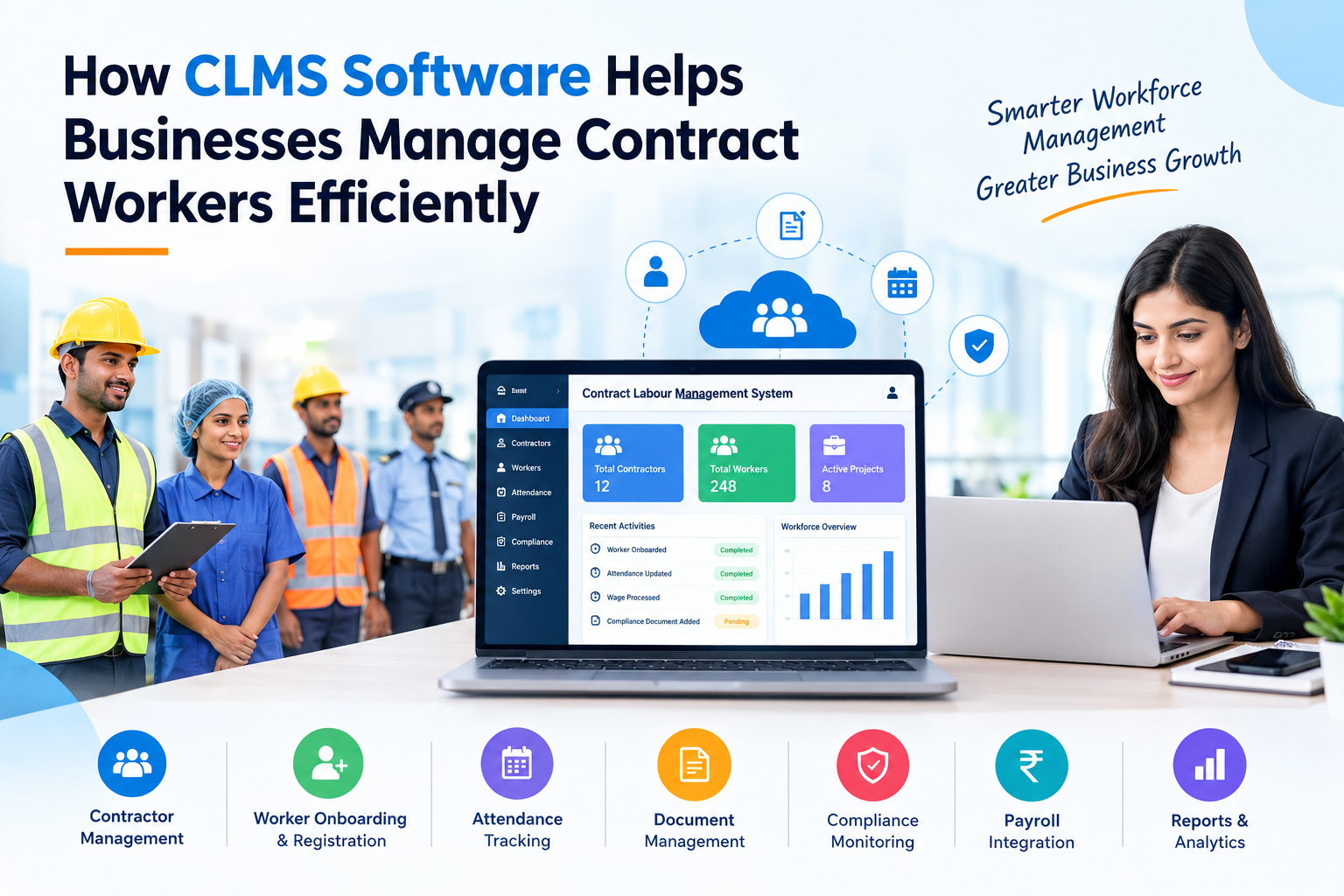
Managing contract workers can become complicated when businesses rely on spreadsheets, paperwork, emails, and disconnected systems. From contractor onboarding and worker records to attendance, wage processing, compliance, and reporting, every stage requires accurate information and timely action. As organizations increasingly depend on flexible and outsourced workforces, technology has become essential for managing contract labour efficiently.
A contract labour management system software provides a centralized platform for organizing contractor-related activities and maintaining workforce information. It helps HR teams, administrators, contractors, and management teams access relevant information while reducing repetitive manual work. With automation and real-time visibility, businesses can create a more structured approach to contract workforce management.
What Is Contract Labour Management Software?
Contract labour management software is a digital solution designed to manage employees and workers hired through contractors or third-party agencies. It can bring multiple workforce processes together, including contractor registration, worker information, attendance tracking, document management, wage details, compliance records, and reporting.
A modern contract labour management system can also connect workforce information with payroll and HR processes. Instead of maintaining separate records across multiple files, businesses can organize important information in one centralized environment.
This approach is particularly useful for organizations managing large numbers of contract workers across different departments, locations, projects, or contractor agencies.
Why Businesses Need a Digital CLMS
Managing contract workers manually can create several operational challenges. HR teams may spend considerable time collecting documents, checking attendance, following up with contractors, preparing reports, and maintaining compliance records.
A digital system can reduce these administrative challenges by creating standardized workflows.
Some common benefits include:
Centralized contractor and worker information
Faster onboarding and registration
Digital document management
Attendance and workforce tracking
Better compliance monitoring
Automated reports
Reduced paperwork
Improved data accuracy
Easier communication with contractors
Better visibility into workforce costs
By automating repetitive activities, organizations can allow HR teams to focus more on workforce planning and employee engagement instead of routine administration.
Key Features of a Contract Labour Management System
A comprehensive contract labour management system software typically includes several features designed specifically for contract workforce operations.
1. Contractor Management
Businesses can maintain contractor profiles, agreements, contact information, workforce details, and relevant documents in a centralized system. This makes it easier to monitor relationships with multiple contractors.
2. Worker Registration and Onboarding
The system can simplify the registration process by capturing worker information and required documentation digitally. Standardized onboarding workflows can reduce delays and minimize missing information.
3. Attendance Management
Tracking attendance is important for calculating wages and monitoring workforce availability. Digital attendance features can help organizations record working hours and maintain reliable attendance information.
4. Document Management
Contract workers may require several documents, certificates, identification records, agreements, and other compliance-related information. Digital document storage makes these records easier to organize and retrieve.
5. Compliance Monitoring
Contract labour operations involve various regulatory and organizational requirements. A centralized system can help HR teams track important records, deadlines, documents, and compliance-related activities.
Businesses should always verify applicable requirements with qualified legal or compliance professionals because obligations can vary based on location, workforce structure, and applicable regulations.
6. Reports and Analytics
Management teams need accurate workforce information to make informed operational decisions. A CLMS can provide reports covering worker strength, attendance, contractor information, wage-related data, and other workforce metrics.
How CLMS Improves HR Efficiency
A labour management system can significantly reduce the amount of manual coordination required between HR departments, contractors, supervisors, and workers.
For example, instead of collecting attendance sheets from different locations and manually consolidating the information, organizations can maintain attendance data within a centralized platform. HR teams can then use this information for verification, reporting, and downstream payroll processes.
Automation also creates more consistent processes. When standardized workflows are used for onboarding, documentation, attendance, and approvals, organizations can reduce inconsistencies caused by manual procedures.
The Importance of CLMS in India
The need for structured contract workforce management has increased as businesses across industries use contractors for projects, manufacturing, facilities, logistics, security, construction, and other operational activities.
A contract labour management system in India can help organizations organize contractor and worker information while supporting more efficient administrative processes. Businesses operating across multiple locations can particularly benefit from centralized workforce visibility.
However, software should complement—not replace—proper compliance processes. Organizations should ensure that their workflows and records align with applicable labour laws, contractual obligations, and internal policies.
Connecting CLMS With Payroll
Attendance, working days, overtime, wage information, and other workforce data can directly affect payroll processing. When these processes operate separately, HR teams may need to transfer information manually, increasing the possibility of errors.
Integrating CLMS with payroll management software can help create a smoother flow of workforce information. Verified attendance and relevant worker data can be made available for payroll processing, reducing repetitive data entry.
This integration can also improve transparency because HR and management teams can trace workforce information more easily from attendance records to payroll-related processes.
CLMS and HRMS Integration
Contract workforce management does not operate independently from broader HR activities. Organizations may also need to manage employee records, attendance, payroll, leave, recruitment, performance, and other HR processes.
Integration with HRMS Software can create a more connected HR environment. Instead of maintaining multiple disconnected databases, businesses can bring relevant workforce information into a coordinated ecosystem.
This can improve data accessibility and help HR professionals manage different workforce categories through standardized digital processes.
Contract Labour Management System Login and Accessibility
Modern cloud-based platforms allow authorized users to access workforce information from different locations. A secure contract labour management system login can provide role-based access to contractors, HR administrators, supervisors, and other authorized users.
This is particularly useful for organizations with geographically distributed operations. Contractors can update relevant information, while HR teams can monitor records and processes without depending entirely on physical paperwork.
Security remains important, so businesses should use appropriate authentication, access controls, data protection measures, and regular system reviews.
Best Practices for Implementing CLMS
Technology alone does not guarantee successful workforce management. Organizations should establish clear processes before implementing a digital system.
Some useful practices include:
Define workforce requirements: Identify the types of contractors, workers, locations, and processes that need to be managed.
Standardize workflows: Establish consistent procedures for onboarding, attendance, documentation, approvals, and reporting.
Maintain accurate records: Regularly review worker and contractor information.
Train users: Provide appropriate training to HR teams, supervisors, and contractors.
Monitor compliance: Track applicable requirements and maintain necessary documentation.
Review reports: Use workforce data to identify operational gaps and improve processes.
Protect information: Apply suitable security and access-control practices.
Future of Contract Workforce Management
The future of contract workforce management is increasingly connected to automation, cloud technology, analytics, mobile accessibility, and integrated HR platforms.
Organizations are moving away from fragmented spreadsheets and paper-based processes toward centralized digital systems. Advanced platforms may increasingly use automation to identify missing information, generate reports, simplify approvals, and provide workforce insights.
As businesses continue adopting flexible workforce models, digital tools will become increasingly important for maintaining operational visibility and administrative efficiency.
Conclusion:
Managing contract workers efficiently requires more than maintaining a list of workers and contractors. Organizations need structured processes for onboarding, attendance, documentation, compliance, reporting, and payroll coordination.
A well-designed contract labour management system can centralize these activities, reduce manual work, and provide better visibility into contract workforce operations. When integrated with payroll management software and HRMS Software, it can also help connect contract workforce processes with broader HR operations.
For businesses managing a growing contract workforce, adopting a structured digital approach can create more consistent processes, improve information accuracy, and support efficient workforce administration.
 Never miss a story from us, get weekly updates in your inbox.