
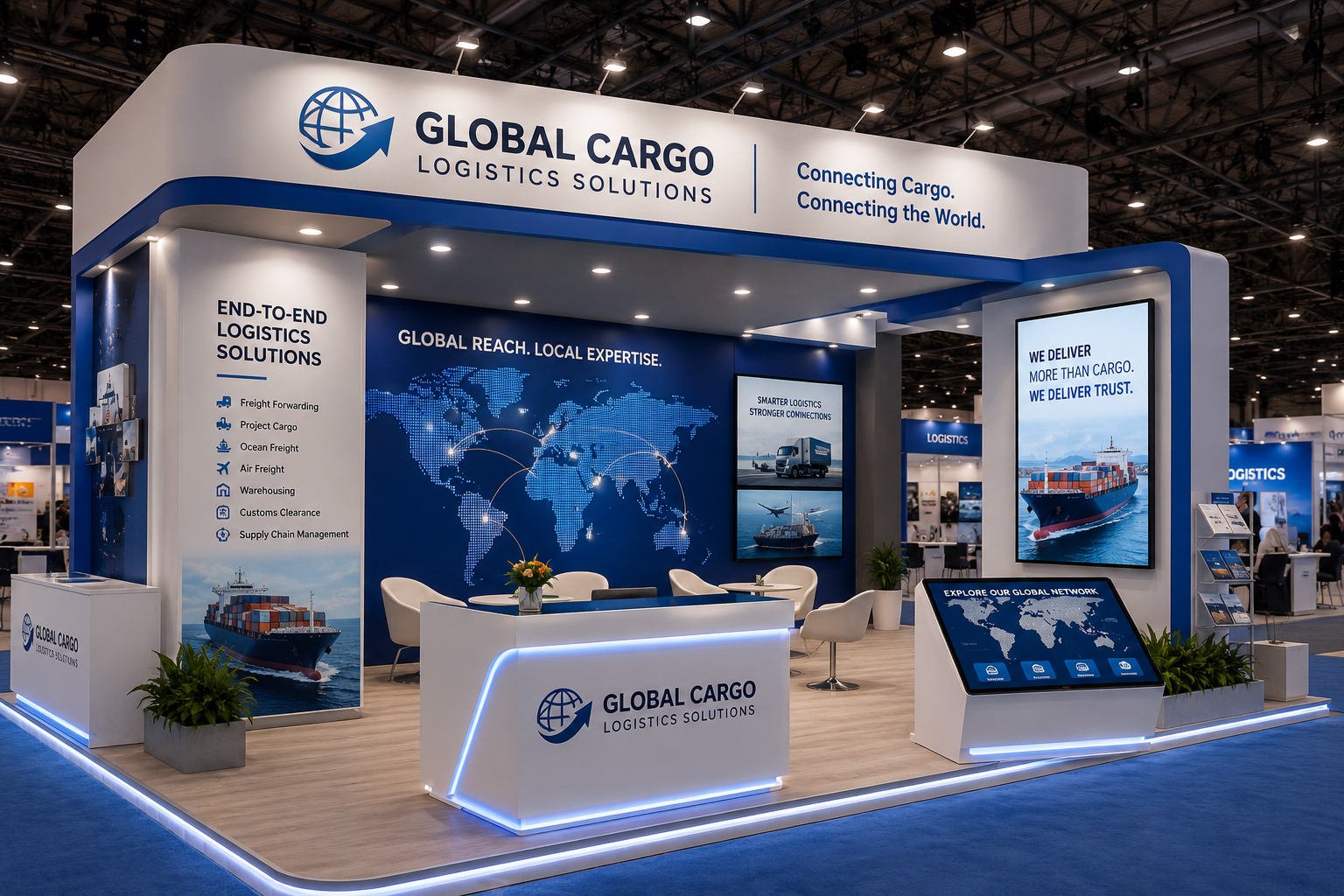
In a busy trade show environment, attracting the right visitors can be challenging for cargo, freight, shipping, and logistics companies. Hundreds of exhibitors may compete for attention, and many booths offer services that appear similar at first glance. This is why an innovative Cargo logistics trade show booth design can become an important part of an exhibitor's marketing strategy. A well-designed booth does more than display a company logo. It creates an inviting environment, communicates services quickly, encourages interaction, and gives potential customers a reason to stop, explore, and start a conversation. When creativity is combined with functionality, the booth can become one of the strongest visitor-attraction tools on the exhibition floor.
Why Visitor Attraction Matters at Logistics Trade Shows
Trade shows provide logistics companies with direct access to industry professionals who may be searching for transportation partners, freight solutions, supply chain services, technology, warehousing, and specialized cargo capabilities.
However, simply participating in a trade show does not guarantee meaningful engagement.
A company may invest significantly in exhibition space but receive limited results if its booth fails to stand out.
Visitors typically walk past dozens of exhibitors during an event. They make quick decisions about which booths deserve their attention.
An innovative booth can influence that decision.
Strong architecture, clear messaging, engaging technology, relevant visuals, and an inviting layout can encourage attendees to slow down and investigate what a company offers.
The objective is not to attract everyone.
The objective is to attract visitors who are genuinely relevant to the company's services and business goals.
Start With a Strong Concept
Innovation begins with the overall concept.
Instead of choosing individual design elements randomly, exhibitors should develop a central idea for the booth.
For a cargo logistics company, the concept could focus on global connectivity, movement, speed, supply chain visibility, technology, reliability, or the journey of cargo from origin to destination.
Once the central idea is established, architecture, graphics, lighting, technology, and visitor experiences can support it.
This creates a cohesive booth rather than a collection of unrelated features.
A strong concept also makes the booth easier for visitors to remember after the event.
Make the Booth Visible From a Distance
The first challenge is attracting attention from the aisle.
Visitors may see the booth from several meters away, so important branding and messaging should be visible before they enter.
Large-format graphics, elevated branding, distinctive architectural elements, illuminated signage, and carefully positioned digital screens can improve visibility.
The company name should be easy to recognize.
The primary message should also be understandable at a glance.
If visitors cannot determine what the company does from the aisle, they may continue walking.
Visibility should therefore be considered from multiple viewing angles.
Use Architecture to Create Curiosity
Traditional rectangular walls may communicate information, but distinctive architecture can create curiosity.
Curved structures, suspended elements, layered walls, open frameworks, and unique overhead features can give the booth a recognizable silhouette.
For logistics companies, architecture can even reflect movement.
Lines, pathways, modular structures, or flowing forms can visually represent transportation networks and supply chains.
The design should remain practical, however.
A visually impressive structure that blocks visitors or reduces usable space may work against the company's objectives.
Create an Open and Welcoming Layout
Innovation should never come at the expense of accessibility.
Visitors are more likely to enter a booth when the entrance feels open.
Avoid unnecessary physical barriers.
Reception counters should not completely block the entrance.
Large displays should not create narrow pathways.
Furniture should be positioned to encourage movement rather than restrict it.
An open layout allows visitors to see staff, displays, meeting areas, and key messages from outside the booth.
This reduces the psychological barrier to entry.
Use a Powerful Visual Story
Logistics can involve complicated processes.
Visitors may not immediately understand everything a company offers.
Visual storytelling can simplify these concepts.
For example, a booth can visually demonstrate how cargo moves through different stages of the supply chain.
A visitor might see the journey from manufacturer to warehouse, port, transportation network, and final destination.
Maps, photographs, illustrations, animated graphics, and digital displays can work together to communicate this story.
The visitor understands the business through an experience rather than through a long explanation.
Turn the Supply Chain Into an Experience
An innovative booth can physically represent the supply chain.
Different sections of the booth can represent different stages of cargo movement.
Visitors can move through these areas while learning about the company's services.
Digital screens can provide information at each stage.
Interactive elements can allow visitors to select different routes or cargo types.
This creates a journey that makes complex logistics concepts easier to understand.
It also gives visitors a reason to spend more time inside the booth.
Use Interactive Technology
Technology can transform passive visitors into active participants.
Touchscreens, interactive maps, digital presentations, product configurators, and service-selection tools can encourage visitors to interact with the company.
For example, an interactive map could allow visitors to select a destination and view available transportation solutions.
Another screen could allow visitors to explore different logistics services based on their business requirements.
Interactive technology is most effective when it solves a communication problem.
It should not be added simply because it looks modern.
Add Immersive Digital Experiences
Large LED screens can create visual impact.
A panoramic screen could display ports, cargo ships, aircraft, trucks, warehouses, or global transportation routes.
A carefully produced video can create the impression that visitors are experiencing the company's operations.
Immersive content can be particularly effective for companies whose services are difficult to demonstrate physically.
For example, a logistics company cannot bring an entire international supply chain into the exhibition hall.
Digital storytelling can bring elements of that operation to life.
Consider Virtual or Augmented Reality
Virtual and augmented reality can provide another level of engagement.
A VR experience could take visitors inside a logistics facility or demonstrate a transportation project.
Augmented reality could allow visitors to point a device at a cargo model and explore additional information digitally.
These technologies can create memorable experiences.
However, the experience should remain short, simple, and relevant.
Visitors may not have time to complete complicated setups during a busy trade show.
Display Real Projects
Innovation does not always mean using advanced technology.
Sometimes the most compelling content is a real project.
Companies can showcase photographs and stories from actual cargo movements.
A project display can explain what the customer needed, what challenges were involved, how the company developed the solution, and what was achieved.
Real examples give visitors something concrete to discuss with representatives.
They also help demonstrate practical experience.
Use Large-Scale Cargo Imagery
High-quality photography can immediately communicate the company's industry.
Images of heavy cargo, ports, ships, aircraft, warehouses, specialized transportation, and logistics operations can create a strong visual connection.
However, generic stock photographs should be used carefully.
Authentic images from the company's own operations can make the booth feel more credible.
A large photograph can become an architectural feature when incorporated thoughtfully into the booth walls or structures.
Make Your Brand Colors Work Harder
Brand colors can help visitors recognize the company quickly.
A consistent color palette can be incorporated into walls, graphics, furniture, lighting, signage, and digital displays.
The goal is not to cover every surface in brand colors.
Instead, colors should guide attention.
A primary brand color can highlight important information.
Supporting shades can distinguish different service areas.
Consistent color usage helps create a unified visual identity.
Use Lighting as an Attraction Tool
Lighting can change the appearance of a booth dramatically.
Illuminated logos can improve visibility.
Backlit graphics can attract attention.
Focused lighting can highlight important displays.
Architectural lighting can make distinctive structures stand out.
Dynamic lighting may also be used in selected areas, although it should not become distracting.
The lighting strategy should support the booth's concept and help guide visitors toward important areas.
Create an Attention-Grabbing Feature
A memorable feature can become the centerpiece of the booth.
For a cargo logistics company, this might be a large-scale cargo model, an interactive global map, an illuminated transportation network, a digital tunnel, or an immersive supply chain installation.
The feature should connect directly to the company's business.
A visitor should be able to understand why it exists.
When the attraction is relevant, it can become a conversation starter for the sales team.
Use Interactive Global Maps
Global maps are naturally suited to logistics companies.
An interactive map can display the company's service areas, transportation routes, facilities, ports, and global network.
Visitors can select different regions to learn more.
The map can also demonstrate how cargo moves between locations.
This is more engaging than simply displaying a static map.
It allows visitors to explore the information according to their interests.
Add Live Demonstrations
Live demonstrations can create a sense of activity.
A company could demonstrate a shipment management platform, tracking system, logistics software, planning tool, or other technology.
Visitors can see the solution working instead of simply hearing about it.
Live demonstrations also give sales representatives natural opportunities to start conversations.
The demonstration should be short enough to accommodate visitors who have limited time.
Use Data as a Visual Element
Logistics companies have access to significant amounts of operational information.
Instead of displaying complex spreadsheets, selected data can become part of the visual experience.
Maps, charts, counters, timelines, and infographics can communicate information more effectively.
For example, a digital display might present the number of countries served, transportation routes, facilities, or other relevant company metrics.
Any figures used should be accurate and appropriately contextualized.
Design for Fast Information Consumption
Trade show visitors often have limited attention spans.
They may spend only a few seconds looking at a graphic before deciding whether to investigate further.
Important information should therefore be easy to consume.
Large headlines, short statements, strong imagery, and simple diagrams can communicate the key message quickly.
Detailed explanations should be available for visitors who want more information.
This layered approach allows both quick visitors and highly interested prospects to engage with the booth.
Create a Clear Value Proposition
Visitors need to understand what makes the company different.
A booth should answer a simple question:
Why should I talk to this company?
The answer could relate to global reach, specialized cargo capabilities, technology, reliability, industry experience, customer service, or integrated logistics solutions.
The value proposition should be prominent.
It should not be hidden beneath technical information.
Use Creative Signage
Signage can guide visitors through the booth.
Instead of generic signs such as "Services" or "About Us," companies can use more engaging messaging.
Signs can ask questions related to common logistics challenges.
For example, a display might focus on improving shipment visibility or managing complex transportation requirements.
This makes the content more relevant to visitors.
Build Conversation Starters Into the Design
An innovative booth should make it easier for staff to start conversations.
A question displayed on a screen can encourage visitors to share their biggest logistics challenge.
A case study can prompt a representative to ask whether the visitor faces similar requirements.
An interactive map can lead to a discussion about international operations.
The design should therefore support the sales process.
Make Staff Part of the Experience
Even the most innovative booth needs knowledgeable people.
Staff members should understand the booth's story and know how to use its technology and displays.
They should be approachable and prepared to answer questions.
Training is important because a poorly explained interactive experience can frustrate visitors.
Staff should also know when to give visitors space.
A welcoming approach can make the entire experience feel more professional.
Provide Comfortable Meeting Areas
Once visitors are interested, they need somewhere to talk.
Comfortable meeting areas can encourage longer discussions.
The design can include open seating for casual conversations and semi-private spaces for more detailed meetings.
Tables should provide enough room for laptops and documents.
Meeting spaces should remain connected to the main booth while offering enough separation for focused discussions.
Integrate Lead Generation
Attracting visitors is only the beginning.
The booth should make it easy to convert interest into a meaningful business opportunity.
Digital lead forms, QR codes, appointment scheduling, and consultation requests can support this process.
The process should be simple.
Visitors should understand what they receive in return for sharing their information.
For example, they might request a project consultation, download a relevant logistics guide, or schedule a discussion with a specialist.
Use QR Codes Strategically
QR codes can connect physical displays with digital content.
A case study display can link to the complete project story.
A service graphic can connect to a detailed service page.
A product demonstration can lead to a video.
The QR code should be placed near the relevant content and accompanied by a clear call to action.
Multiple QR codes should not be scattered randomly across every surface.
Create a Social Media-Friendly Booth
Visitors often photograph interesting exhibition displays.
A visually distinctive booth can encourage organic social sharing.
A creative architectural feature, large branded installation, interactive map, or memorable visual can become a natural photo opportunity.
The company can also create branded digital content that visitors can easily share.
This can extend the booth's visibility beyond the exhibition hall.
Keep the Design Professional
Creativity should not make the booth look unprofessional.
Cargo and logistics services often involve significant business decisions.
The booth needs to communicate reliability and competence.
Innovative architecture and technology should therefore be balanced with professional branding and clear information.
The best designs feel modern without becoming unnecessarily complicated.
Make Innovation Relevant to the Industry
A logistics company should avoid adding technology merely to impress visitors.
Every innovative feature should have a purpose.
If an interactive map explains global operations, it is useful.
If a digital simulation demonstrates a complex process, it is useful.
If a physical model helps explain project cargo, it is useful.
But technology that has no connection to the company's services may distract visitors.
Relevance is more valuable than novelty.
Consider Sustainability
Modern exhibition design can also incorporate sustainable practices.
Reusable structures, modular components, digital literature, recyclable materials, and efficient lighting can reduce unnecessary waste.
Sustainability can become part of the booth's story if it aligns with the company's broader business strategy.
A digital brochure, for example, can reduce the need for large quantities of printed material.
Reusable modular structures can also be adapted for multiple exhibitions.
Design for Different Booth Sizes
Innovation does not require an enormous exhibition space.
A small booth can use vertical branding, interactive screens, strong graphics, and efficient furniture.
A larger booth can incorporate meeting rooms, demonstrations, immersive experiences, and multiple visitor zones.
The design should adapt to the available space.
The objective is to maximize the impact of every square meter.
Think About the Entire Visitor Journey
An effective booth should be planned around the complete visitor journey.
First, the visitor notices the booth from the aisle.
Then they recognize the company and understand its primary message.
Next, something captures their interest.
They enter the booth and explore a display.
A staff member starts a conversation.
The visitor learns about a relevant solution.
Finally, the visitor shares contact information or schedules a follow-up meeting.
Every design element should support this journey.
Measure What Works
After the event, companies should evaluate the booth's performance.
They can review visitor traffic, qualified leads, meetings, demonstrations, QR-code scans, appointment requests, and follow-up opportunities.
Staff can also provide feedback.
Which display attracted the most attention?
Which demonstration generated the most questions?
Which case studies started conversations?
Which areas remained unused?
These insights can improve future exhibitions.
Work With the Right Booth Design Partner
Turning an innovative concept into a functional exhibition environment requires careful planning.
A professional booth-building partner can coordinate architecture, graphics, lighting, furniture, digital technology, storage, installation, and visitor flow.
The right partner should understand both creative design and practical exhibition requirements.
For cargo and logistics companies, industry-relevant experience can also help ensure that complex services are presented clearly.
Final Thoughts
An innovative booth can give cargo and logistics companies a stronger opportunity to compete for attention at busy industry exhibitions. However, innovation should always have a purpose. A successful booth combines strong branding, visible architecture, compelling graphics, interactive technology, real project stories, clear messaging, comfortable meeting spaces, and an intuitive visitor journey. The most effective designs do not simply make people stop; they give visitors a reason to stay, explore, ask questions, and begin meaningful business conversations. Companies that approach their exhibition presence from the visitor's perspective can create a more memorable and productive experience while strengthening their overall brand image. With the right planning, creative execution, and professional booth-building support, Cargo logistics trade show booth design can become a powerful tool for attracting qualified visitors, communicating complex logistics solutions, generating leads, and creating valuable opportunities at the trade show.
 Never miss a story from us, get weekly updates in your inbox.