
Vacuum furnaces are complex industrial systems designed to deliver controlled heat treatment under low-pressure conditions. Their performance depends not on a single part, but on how multiple core components operate together to maintain vacuum integrity, temperature accuracy, and process repeatability.
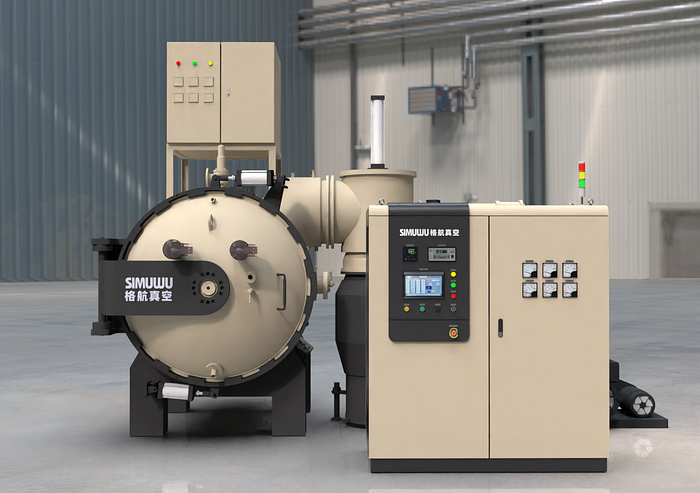
At a high level, a vacuum furnace is built around several essential subsystems:
- Furnace Chamber
- Vacuum System
- Heating System
- Cooling System
- Control System
Each plays a distinct role, and weaknesses in any one of them directly affect product quality, cycle stability, and equipment lifespan.
Furnace chamber forms the structural foundation. Its material selection, sealing design, and geometry determine the achievable temperature range, vacuum level, and load capacity. Poor chamber design often leads to temperature non-uniformity or persistent vacuum leaks, both of which are difficult to compensate for downstream.
Vacuum system establishes and maintains the low-pressure environment required to prevent oxidation and contamination. This system is not just about pumps; valve configuration, piping layout, and sealing quality are equally decisive. Different heat treatment processes impose very different requirements on ultimate vacuum level, pumping speed, and cleanliness.
Heating system supplies thermal energy and defines the usable temperature window of the furnace. Choices between graphite, molybdenum-based elements, or induction heating influence heating rates, temperature uniformity, and long-term maintenance costs. Temperature sensing and feedback devices must work in close coordination with the heating elements to avoid overshoot and process drift.
Cooling system controls how heat is removed after the thermal cycle. Gas quenching, oil quenching, and circuit design all affect cooling rates, distortion control, and final material properties. Inadequate cooling design often results in inconsistent metallurgical outcomes even when heating is well controlled.
Control system coordinates all subsystems into a repeatable process. PLC logic, sensor feedback, and the human-machine interface determine how accurately the furnace follows programmed cycles and how effectively operators can monitor deviations or faults.
This overview only outlines the functional logic behind each core component. Design details, component interactions, common failure modes, and selection considerations vary significantly by furnace type and application.
The complete, in-depth explanation is available in the original article:
https://www.simuwufurnace.com/what-are-the-core-components-of-a-vacuum-furnace/
 Never miss a story from us, get weekly updates in your inbox.